
"You stole, please return some." Coldcard hacker's wallet becomes a graffiti wall of pleas and hustles
AI-summarised from reporting by CoinDesk. How we use AI.
What happened
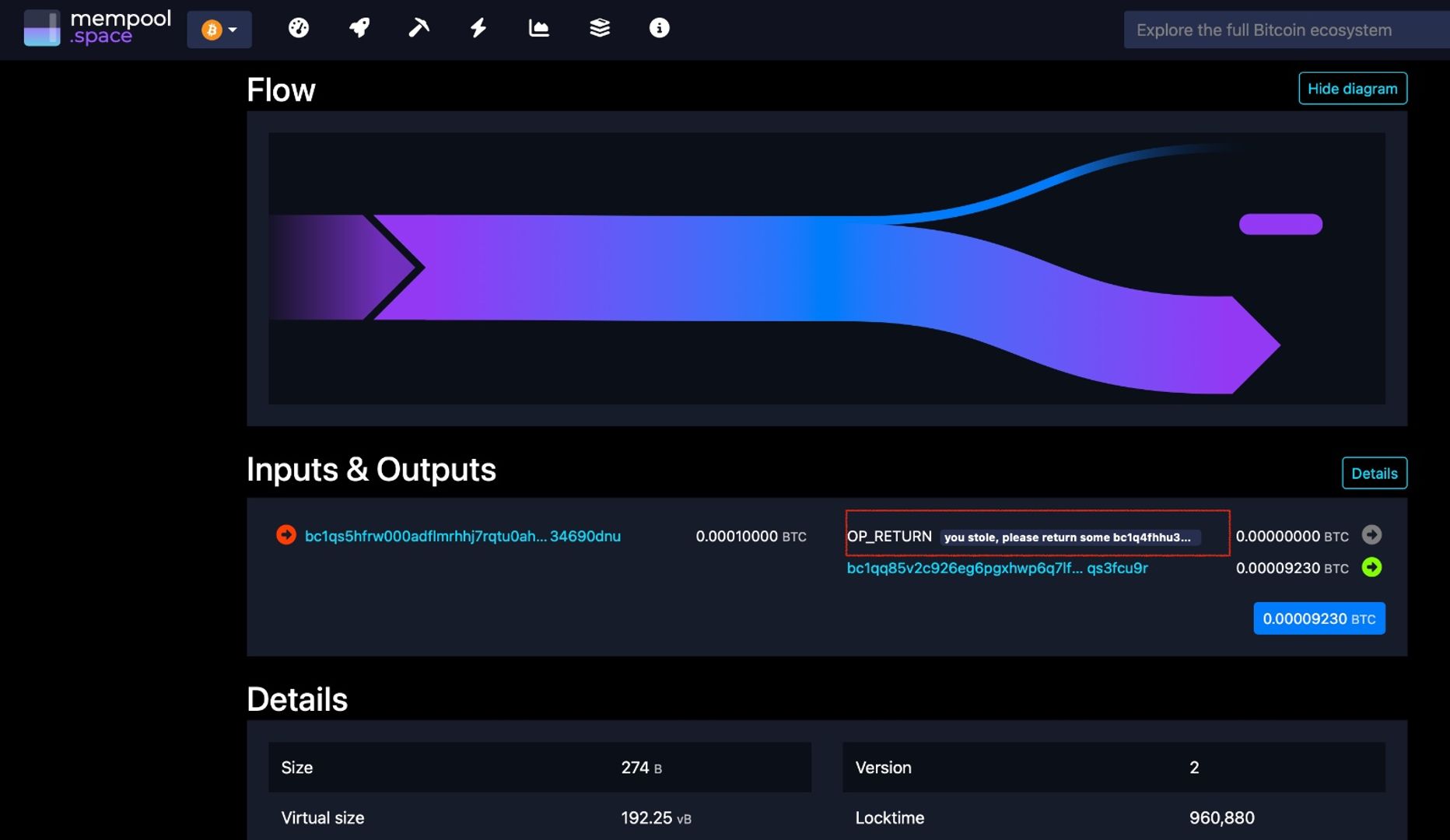
A digital wallet containing a substantial sum of stolen Bitcoin, estimated at approximately $36 million AUD at the time of the incident, has transformed into an unusual public forum. This wallet, linked to a significant cryptocurrency theft, has seen a multitude of transactions where individuals are paying small amounts of Bitcoin to embed messages on the blockchain. These messages are largely directed at the alleged thief, ranging from pleas for the return of funds to outright demands and even attempts to negotiate a 'finder's fee'.
The phenomenon highlights a peculiar aspect of blockchain technology: its immutable and transparent nature. Every transaction, including those with embedded messages, is permanently recorded and publicly viewable. This permanence has led to a unique form of digital 'graffiti', where the stolen funds' address becomes a canvas for victims and other interested parties to communicate directly with the perpetrator, or at least to publicly express their sentiments.
Initially, the wallet garnered attention due to the sheer volume of stolen assets. However, the subsequent influx of these message-laden transactions has amplified its notoriety. The messages often include specific transaction IDs, alleged wallet addresses of victims, and various appeals, turning a stolen funds account into a living ledger of protest and negotiation attempts. This situation underscores the ongoing challenges of asset recovery in the decentralised world of cryptocurrency.
The hacker, believed to be responsible for exploiting vulnerabilities in a well-known hardware wallet, has so far remained unresponsive to these blockchain-based communications. The continuous flow of messages, however, demonstrates the persistent hope among victims and the broader crypto community that a portion of the stolen funds might eventually be returned, or at least acknowledged, in this public ledger.
Why it matters for Australian investors
For Australian cryptocurrency investors, this incident serves as a stark reminder of the inherent risks associated with digital asset security. While the specific hack may not have directly impacted Australian exchanges like CoinSpot, Independent Reserve, Swyftx, or BTC Markets, the underlying principle of securing one's assets against theft remains paramount. Investors here often hold significant portions of their portfolios in Bitcoin, making any large-scale theft event globally relevant.
The permanence of blockchain transactions, as evidenced by the 'message wall', is a double-edged sword. While it offers transparency for tracking stolen funds, it also means that once a transaction is confirmed, it's irreversible. This characteristic underpins the importance of robust security practices, including the use of reputable hardware wallets, strong, unique passwords, and multi-factor authentication, which Australian investors are increasingly adopting.
Moreover, the incident subtly reinforces the Australian Taxation Office (ATO)'s stance on cryptocurrency as an asset. Stolen or lost cryptocurrencies still factor into an individual's tax obligations, often requiring careful record-keeping for capital gains or losses, even in such unfortunate circumstances. Understanding the implications of such events on one's tax position is crucial for Australian investors.
Finally, the ongoing public display of pleas and negotiations on the blockchain underscores the lack of centralised recourse in the crypto space. Unlike traditional finance where regulatory bodies like ASIC or AUSTRAC might intervene more directly in asset recovery, the decentralised nature of cryptocurrencies often leaves victims with limited options, highlighting the 'buyer beware' aspect that Australian investors must constantly consider.
Impact on the AUD market
While this specific hack did not directly involve Australian dollar-denominated stablecoins or directly impact the liquidity of AUD trading pairs on local exchanges, large-scale thefts can have indirect effects. Significant hacks, especially of a prominent asset like Bitcoin, can ripple through global crypto markets, potentially influencing investor sentiment and, by extension, the AUD-denominated price of Bitcoin and other cryptocurrencies.
Should there be a general downturn in confidence following such incidents, Australian investors trading on platforms like CoinSpot or Swyftx might observe increased volatility in AUD-paired cryptocurrencies. Such events contribute to the overall perception of market risk, which can influence how Australian institutions and individual investors allocate their capital within the digital asset space.
Furthermore, the media coverage and public discourse around these incidents can shape regulatory attitudes. While AUSTRAC focuses on anti-money laundering and counter-terrorism financing, and ASIC on consumer protection, the prevalence of hacks could prompt further scrutiny or calls for enhanced security standards, potentially impacting how Australian exchanges operate and report incidents.
Ultimately, while the direct financial impact on the AUD market from this specific event is likely minimal, the psychological and reputational effects within the global crypto ecosystem are undeniable. Australian investors operate within this global market, and thus, sentiments and security concerns from anywhere can echo across the local landscape, affecting confidence and trading behaviour.
What to watch next
Investors should continue to monitor the hacker's wallet address for any activity. A partial return of funds, or any communication from the perpetrator, would be a significant development. Such an event, while unlikely, could signal a shift in the landscape of crypto theft recovery and potentially influence how similar future incidents are handled.
Beyond the specific wallet, it's crucial to observe how major hardware wallet providers and cryptocurrency exchanges respond to the broader implications of this hack. Enhanced security features, more rigorous audit processes, and improved customer support mechanisms are all areas where the industry might evolve in light of such high-profile incidents. Australian exchanges and wallet providers are equally incentivised to continually bolster their security postures.
Regulatory developments, both domestically and internationally, warrant close attention. As global incidents like this continue to unfold, there may be increased pressure on bodies like ASIC and AUSTRAC to develop clearer guidelines for asset recovery, investor protection, and reporting of cybercrimes in the crypto sector. Any moves towards international cooperation in tracing and seizing stolen digital assets would also be noteworthy.
Finally, the ongoing narrative around security best practices remains paramount. For Australian investors, this means consistently reviewing and upgrading personal security measures, staying informed about the latest scams and vulnerabilities, and exercising extreme caution with private keys and digital asset storage. The 'graffiti wall' serves as a perpetual, if unusual, reminder of the ever-present need for vigilance in the decentralised world.
Coins covered


Common questions
What happens if my Bitcoin is stolen in Australia?
If your Bitcoin is stolen in Australia, you should report it to the police and your financial institution (if applicable). While the immutable nature of blockchain makes reversing transactions difficult, providing details to law enforcement can assist in tracing the funds. You should also consult the ATO regarding potential capital losses for tax purposes.
Are Australian cryptocurrency exchanges like CoinSpot or Swyftx safe?
Reputable Australian cryptocurrency exchanges like CoinSpot, Independent Reserve, Swyftx, and BTC Markets employ various security measures to protect user funds, including cold storage, two-factor authentication, and robust compliance with AUSTRAC regulations. However, no system is entirely immune to sophisticated attacks. Users are encouraged to utilise all available security features and consider hardware wallets for long-term storage of significant assets.
How does the ATO treat stolen cryptocurrency for Australian investors?
The ATO generally treats cryptocurrency as property for tax purposes. If your cryptocurrency is stolen, it may be considered a 'capital loss' for capital gains tax (CGT) purposes. You would need to provide evidence of the theft and the original cost basis of the assets. It's advisable to keep meticulous records of all your crypto transactions and consult a tax professional for specific advice.
A hacker's wallet becomes a public blockchain 'graffiti wall' for stolen Bitcoin pleas. Discover what this means for Australian crypto investors.
About this article: this is an AI-generated summary of reporting by CoinDesk. It has not been reviewed by a human editor. We use AI to localise crypto news for Australian readers, and we link back to the original source so you can verify the facts.
Informational only — not financial advice. Always do your own research. Read our AI & editorial policy →