
Why is the Pi Network (PI) Price Down This Week? (June 9)
AI-summarised from reporting by Crypto Potato. How we use AI.
What happened
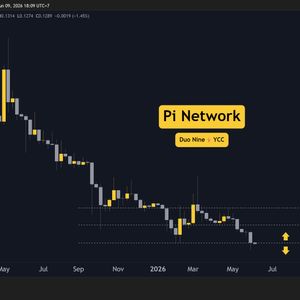
The Pi Network's native cryptocurrency, PI, has experienced a notable downturn, shedding another 10% this week. This recent decline saw PI break below a crucial support level at US$0.13, which has now transitioned into a key resistance point. The asset's struggle to maintain this threshold signals intensifying selling pressure in the market.
Further analysis of the volume profile reveals a sustained pattern of selling pressure since mid-May. This trend culminated last week when PI’s price decisively breached the US$0.13 mark. While there was a brief resurgence of buying activity earlier this week, it was insufficient to reclaim the lost ground, with PI only briefly testing the US$0.13 level before retreating.
Currently, market participants are observing a struggle around this pivotal US$0.13 level. The outcome of this contest between buyers and sellers is expected to dictate PI's short-term price trajectory. Should sellers maintain control, the next likely target for the asset is US$0.10, which market analysts suggest could act as a magnet for the price.
Why it matters for Australian investors
For Australian investors considering or holding PI, this price movement underscores the highly speculative nature of unlisted digital assets. While PI is not widely available on regulated Australian exchanges like CoinSpot, Independent Reserve, Swyftx, or BTC Markets, its price action can serve as a potent reminder of the volatility inherent in nascent crypto projects that operate outside mainstream market structures.
Australian investors are encouraged by ASIC and AUSTRAC to exercise extreme caution with assets that lack clear regulatory oversight or established trading venues. The challenge of easily converting PI to fiat currency like AUD, given its limited exchange listings, adds another layer of risk, affecting liquidity and potential exit strategies. Investment decisions should always be based on thorough research and a clear understanding of the project's fundamentals, rather than speculative hype.
Furthermore, the Australian Taxation Office (ATO) treats cryptocurrency as property for tax purposes. Any gains derived from the sale or disposal of PI, even if acquired through 'mining' or other mechanisms, would generally be subject to Capital Gains Tax (CGT). Conversely, losses can be used to offset capital gains. Australian investors must maintain meticulous records of their crypto transactions to ensure compliance with ATO regulations, irrespective of the asset's market performance.
Impact on the AUD market
The direct impact of PI's recent price slump on the broader Australian dollar (AUD) cryptocurrency market is likely minimal. Given PI's limited listing on Australian-centric exchanges and its relatively peripheral status in the local digital asset ecosystem, its price fluctuations typically do not ripple through major AUD-denominated trading pairs or significant Australian market sentiment. Unlike major cryptocurrencies such as Bitcoin or Ethereum, whose movements can sometimes correlate with broader economic indicators, PI's performance tends to be isolated.
However, the situation does highlight a broader theme relevant to the AUD crypto market: the risks associated with highly speculative assets. Australian investors, often new to the crypto space, might be drawn to low-priced tokens without fully understanding their underlying utility or market dynamics. This incident serves as a pertinent case study, reinforcing the message that not all digital assets offer the same level of liquidity, access, or regulatory clarity that Australian investors might expect from more established crypto offerings on AUSTRAC-registered exchanges.
It also subtly influences investor behaviour. When less established tokens experience significant price drops, it can lead to increased caution among some Australian retail investors, potentially driving them towards more liquid, well-understood assets, or even away from the crypto market altogether. For those trading on platforms that offer PI-related derivatives or unofficial trading channels, the risk of significant loss is amplified due to the lack of regulatory protections common in Australia's financial markets.
What to watch next
Looking ahead, Australian investors with an interest in the Pi Network will be closely monitoring the US$0.10 level. Should PI fail to find support there, analysts suggest it could enter a phase of further decline, establishing new lows. A sustained break below this point would signal a significant erosion of buyer confidence and could make any recovery challenging in the near term.
Conversely, the daily Relative Strength Index (RSI) has shown a higher low, which introduces a potential "bullish divergence." This technical indicator suggests that while the price has been falling, the selling momentum might be losing some of its intensity. For this divergence to translate into a price recovery, PI would need to form a definitive bottom below US$0.13 and then begin a consistent upward trajectory.
Until such a recovery materialises, market sentiment suggests PI may remain in a downtrend. This period of potential consolidation or further decline could, for some speculative buyers, present an opportunity, provided a robust recovery follows. However, without clear signs of a turnaround, many seasoned investors would likely advise patience, advocating for a "wait and see" approach rather than attempting to catch a falling knife. Australians should ensure any trading takes place within the context of their personal financial goals and risk tolerance, remembering that past performance does not guarantee future results.
Coins covered



Common questions
Is Pi Network (PI) available on Australian crypto exchanges like CoinSpot or Swyftx?
Based on current information, Pi Network (PI) is not widely available on major regulated Australian cryptocurrency exchanges such as CoinSpot, Independent Reserve, Swyftx, or BTC Markets. Its trading is typically confined to less established platforms or unofficial peer-to-peer channels, which carry higher risks due to limited regulatory oversight in Australia.
How does the ATO tax Pi Network (PI) in Australia?
The Australian Taxation Office (ATO) generally treats all cryptocurrencies, including Pi Network (PI), as property for tax purposes. This means any profits made from selling, exchanging, or disposing of PI are subject to Capital Gains Tax (CGT). Losses can also be used to offset capital gains. Australian investors must keep detailed records of all transactions to comply with ATO requirements.
What are the risks for Australian investors looking at speculative altcoins like Pi Network (PI)?
Australian investors face several risks with highly speculative altcoins like Pi Network (PI). These include extreme price volatility, limited liquidity due to restricted exchange listings, and a lack of regulatory protections compared to assets on AUSTRAC-registered platforms. The difficulty in converting such assets to AUD and the speculative nature of their underlying projects also contribute to significant investment risk.
Pi Network's PI token sees a 10% drop, breaking key support. CoinPulse AU analyses what this means for Australian investors, ATO tax implications & future out
About this article: this is an AI-generated summary of reporting by Crypto Potato. It has not been reviewed by a human editor. We use AI to localise crypto news for Australian readers, and we link back to the original source so you can verify the facts.
Informational only — not financial advice. Always do your own research. Read our AI & editorial policy →