
SEC Commissioner Peirce counters views that crypto rule will foster synthetic tokens
AI-summarised from reporting by CoinDesk. How we use AI.
What happened
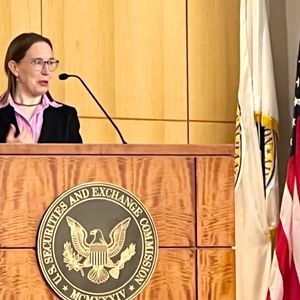
US Securities and Exchange Commission (SEC) Commissioner Hester Peirce, a notable voice within the agency often dubbed 'Crypto Mom' for her supportive stance on digital assets, has weighed in on an upcoming SEC proposal. Her recent statements aim to clarify potential misconceptions surrounding the rule, particularly concerning its impact on synthetic crypto tokens. While the full details of the proposal remain under wraps, Peirce's comments indicate that the SEC is grappling with how to regulate new and evolving financial products within the digital asset space.
Commissioner Peirce's intervention appears to address concerns that the proposed rule, once released, might inadvertently encourage the creation or proliferation of synthetic crypto tokens. Synthetic tokens are essentially derivatives that mimic the price and characteristics of an underlying asset without requiring direct ownership of that asset. Her pre-emptive remarks suggest a nuanced approach from at least some within the SEC, seeking to balance investor protection with innovation rather than stifle new developments outright.
Details are scarce, but it's clear the SEC is actively considering how existing securities laws apply to the burgeoning crypto market. The underlying proposal likely touches upon definitions of securities in the digital realm and how various crypto-related financial products should be classified and regulated. This ongoing discussion reflects broader global regulatory challenges as authorities try to keep pace with rapid technological advancements in finance.
Why it matters for Australian investors
While this development originates from the US SEC, its implications could ripple through global cryptocurrency markets, including here in Australia. The US market is a significant driver of sentiment and regulatory precedents. What happens there often influences regulatory thinking in other jurisdictions, including discussions among Australian bodies like ASIC and AUSTRAC. A clear, well-defined US regulatory framework, or even the process of its formation, can set a benchmark for how other nations approach digital asset regulation.
For Australian investors holding a diverse portfolio, including assets traded on international exchanges or those with global liquidity, US regulatory clarity could reduce overall market uncertainty. Reduced uncertainty can, in turn, lead to greater institutional interest and potentially more stable market conditions. Conversely, overly restrictive or ambiguous US regulations could contribute to market volatility that would undoubtedly affect AUD-denominated crypto prices on local exchanges such such as CoinSpot, Independent Reserve, Swyftx, and BTC Markets.
Moreover, the concept of synthetic tokens itself is relevant. If the US takes a particular stance on these products, it could inform how Australian regulators might view or classify similar financial innovations. This could impact tax treatment from the Australian Tax Office (ATO) for investors involved with such products, as the ATO often looks to international interpretations for guidance on novel financial instruments. Understanding the regulatory landscape, even offshore, can help Australian investors anticipate potential shifts in domestic policy and adjust their investment strategies accordingly.
Impact on the AUD market
The Australian dollar (AUD) denominated crypto market, while distinct, is not insulated from global regulatory trends. Major regulatory announcements from the US, especially concerning market structure or product definitions, frequently trigger price movements across exchanges worldwide. For example, if the SEC's eventual rule on synthetic tokens is perceived as either highly favourable or unduly harsh, it could cause significant price reactions in major cryptocurrencies, which would then be reflected in AUD trading pairs on Australian platforms.
Australian exchanges closely monitor international regulatory shifts to ensure compliance and to gauge potential impacts on their offerings. A clear regulatory pathway for certain types of crypto assets in the US might encourage Australian service providers to explore similar offerings, assuming they comply with local Australian financial services laws. Conversely, a crackdown could lead to delistings or restrictions on access for Australian users to certain products.
From an investment perspective, Australian portfolios that include global crypto assets could see direct impacts. For instance, if a US ruling clarifies how a specific type of asset is regulated, it could affect its liquidity or valuation, which will then translate to its AUD equivalent. The interplay between global regulatory clarity and market stability is crucial for attracting mainstream Australian finance into the crypto space, moving beyond early adopters.
What to watch next
The primary focus for Australian investors and the broader crypto community will be the official release of the SEC's proposal. Commissioner Peirce's comments are merely a precursor; the full text of the rule will reveal the actual scope and specifics. Analysing the definitions used, the types of assets covered, and the compliance requirements will be critical. Pay close attention to how the SEC defines 'synthetic tokens' and how these definitions align or diverge from existing financial derivative classifications.
Next, observe the market reaction once the proposal is public. Will major cryptocurrencies experience significant volatility, or will the market absorb the news calmly? This reaction will be a telling indicator of how investors interpret the SEC's direction. Also, watch for any subsequent statements or clarifications from other SEC commissioners as the debate unfolds. Their differing viewpoints often highlight areas of contention and potential future amendments.
Finally, monitor how Australian regulatory bodies, particularly ASIC and AUSTRAC, respond to these US developments. While they operate independently, they often draw insights from international precedents. Any local statements, consultation papers, or proposed changes to Australian financial services laws or tax guidance from the ATO that reference foreign regulatory actions would be highly significant. This ongoing global regulatory harmonisation, or indeed divergence, will continue to shape the investment landscape for Australian crypto holders.
Coins covered

Common questions
How does US crypto regulation impact my taxes in Australia?
While the ATO operates independently, major regulatory shifts in the US can indirectly influence tax considerations in Australia. US decisions can set precedents or inform international common practices, which the ATO may review when formulating or updating its guidance on novel crypto products. If a product's classification changes globally, the ATO might reassess its tax treatment for Australian investors.
Will US regulatory changes affect the price of Bitcoin or Ethereum on Australian exchanges?
Yes, significant US regulatory announcements often lead to global market reactions, causing price movements for major cryptocurrencies like Bitcoin and Ethereum. These global price changes are typically reflected almost immediately on Australian exchanges like CoinSpot, Independent Reserve, Swyftx, and BTC Markets, affecting their AUD-denominated prices.
What are synthetic crypto tokens and why is the SEC interested in them?
Synthetic crypto tokens are digital assets designed to mirror the value and performance of another underlying asset, such as a traditional stock, commodity, or another cryptocurrency, without actually holding the underlying asset. The SEC is interested because these products often operate in regulatory grey areas, potentially blurring the lines between traditional securities and novel digital assets, raising concerns about investor protection and market integrity.
CoinPulse AU analyses SEC Commissioner Hester Peirce's comments on synthetic crypto tokens and their potential implications for Australian investors and the A
About this article: this is an AI-generated summary of reporting by CoinDesk. It has not been reviewed by a human editor. We use AI to localise crypto news for Australian readers, and we link back to the original source so you can verify the facts.
Informational only — not financial advice. Always do your own research. Read our AI & editorial policy →