
RSI Crashes to 16 as Bitcoin Consolidates Near $61,000 After $59.1K Low
AI-summarised from reporting by Bitcoin.com. How we use AI.
What happened
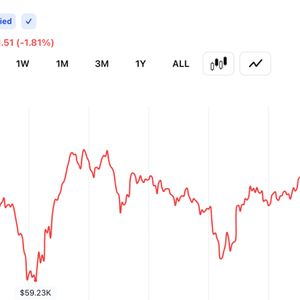
Bitcoin recently experienced a significant price correction, dipping as low as $59,100 over a weekend sell-off. This sharp decline represented a notable shift in market sentiment, catching many participants off-guard. The drop was particularly pronounced, leading to a volatile 24-hour period across the crypto market.
Following this low, Bitcoin saw a subsequent recovery as buyers stepped in to reclaim some lost ground. The asset managed to climb back above the $61,600 mark. As of early morning on June 6, 2026, Bitcoin's price was consolidating within a tighter range, trading between approximately $60,800 and $61,000. This stabilization suggests a period of re-evaluation after the intense volatility.
The immediate aftermath of the sell-off saw significant market activity, with various metrics reacting to the price movement. While specific technical indicators like the Relative Strength Index (RSI) are often cited in such corrections, the overarching sentiment pointed to a battle between bearish pressure and renewed buying interest. This price action underscores the inherent volatility characteristic of the cryptocurrency market.
Why it matters for Australian investors
For Australian investors, Bitcoin's price movements have direct implications, especially for portfolios exposed to digital assets. A sudden dip, even if followed by a recovery, highlights the importance of risk management strategies. Australians often use local exchanges like CoinSpot, Independent Reserve, Swyftx, and BTC Markets, where such price shifts are reflected immediately in AUD pairings.
While this specific event didn't break any major long-term trends, it serves as a reminder of crypto market dynamics. Investors should be aware that even established assets like Bitcoin can experience swift corrections. Understanding these patterns is crucial for making informed decisions, particularly given the ATO's clear guidance on the tax treatment of cryptocurrency gains and losses in Australia.
Market analysis often points to various macro factors influencing Bitcoin, and these global trends inevitably filter down to the Australian market. Local sentiment, while somewhat independent, is heavily swayed by international price action. Therefore, monitoring global Bitcoin performance is paramount for Australian investors, even when trading on AUD-denominated platforms.
Impact on the AUD market
The weekend's price action had a ripple effect across the Australian cryptocurrency landscape. When Bitcoin experiences a sharp downturn, it typically drags down the value of altcoins, impacting the overall market capitalisation visible on Australian exchanges. Investors holding a diversified crypto portfolio may have seen their holdings fluctuate significantly in AUD terms.
Local liquidity providers and market makers on platforms regulated by AUSTRAC would have been actively managing their positions during this volatile period. While no specific Australian exchange data has been released regarding the correction, it's reasonable to infer increased trading volumes as both buyers and sellers reacted to the price fluctuations. This often leads to wider bid-ask spreads temporarily on local order books.
From a regulatory perspective, events like these reinforce the need for robust consumer protection, a focus for bodies like ASIC. While Bitcoin itself is decentralised, the platforms Australians use to access it operate under various regulatory obligations designed to protect participants during periods of market stress. This incident underscores the importance of choosing compliant and reputable Australian platforms.
What to watch next
Looking ahead, Australian investors should closely monitor Bitcoin's price consolidation. The ability of Bitcoin to maintain its current levels and potentially push higher will be a key indicator of market resilience. Any sustained break below the recent low of $59,100 could signal further bearish pressure, while a decisive move above $61,600 might indicate renewed bullish momentum.
Beyond immediate price action, keep an eye on global economic indicators and any shifts in central bank policies, as these often influence investor appetite for risk assets like Bitcoin. Broader sentiment in traditional markets can also spill over into crypto. For Australian investors, this means paying attention to how these global narratives are interpreted and priced into the AUD market.
Furthermore, regulatory developments both globally and within Australia could also impact future market movements. AUSTRAC's ongoing work in regulating digital currency exchanges, coupled with ASIC's approach to crypto investment products, provides a framework that can influence investor confidence. Staying informed about these various factors will be crucial for navigating the evolving crypto landscape.
Coins covered

Common questions
How does Bitcoin's price impact my AUD crypto holdings?
Bitcoin's price movements significantly influence the broader cryptocurrency market, including your AUD-denominated holdings. As the largest cryptocurrency, Bitcoin often acts as a benchmark, and its dips or surges typically lead to similar, though sometimes more amplified, movements in altcoins. Australian exchanges report prices in AUD, so these fluctuations are directly reflected in the value of your portfolio.
What Australian crypto exchanges are available to trade Bitcoin?
Australian investors have several reputable local exchanges to trade Bitcoin. Popular options include CoinSpot, Independent Reserve, Swyftx, and BTC Markets. These platforms allow you to directly buy and sell Bitcoin using Australian dollars and are regulated by AUSTRAC for anti-money laundering and counter-terrorism financing compliance.
Do I pay tax on Bitcoin gains in Australia, and how does the ATO treat it?
Yes, in Australia, the Australian Taxation Office (ATO) generally treats cryptocurrency, including Bitcoin, as property for tax purposes. This means that if you sell, trade, or otherwise dispose of Bitcoin for a profit, it's usually subject to Capital Gains Tax (CGT). Losses can also be offset against capital gains. It's crucial for Australian investors to keep detailed records of all transactions to accurately calculate their tax obligations.
Bitcoin's recent price dip to $59,100, followed by a recovery, signals volatility. CoinPulse AU analyses what this means for Australian investors and the AUD
About this article: this is an AI-generated summary of reporting by Bitcoin.com. It has not been reviewed by a human editor. We use AI to localise crypto news for Australian readers, and we link back to the original source so you can verify the facts.
Informational only — not financial advice. Always do your own research. Read our AI & editorial policy →