
Morgan Stanley expands crypto lineup with Ether, Solana ETPs
AI-summarised from reporting by Cointelegraph. How we use AI.
What happened
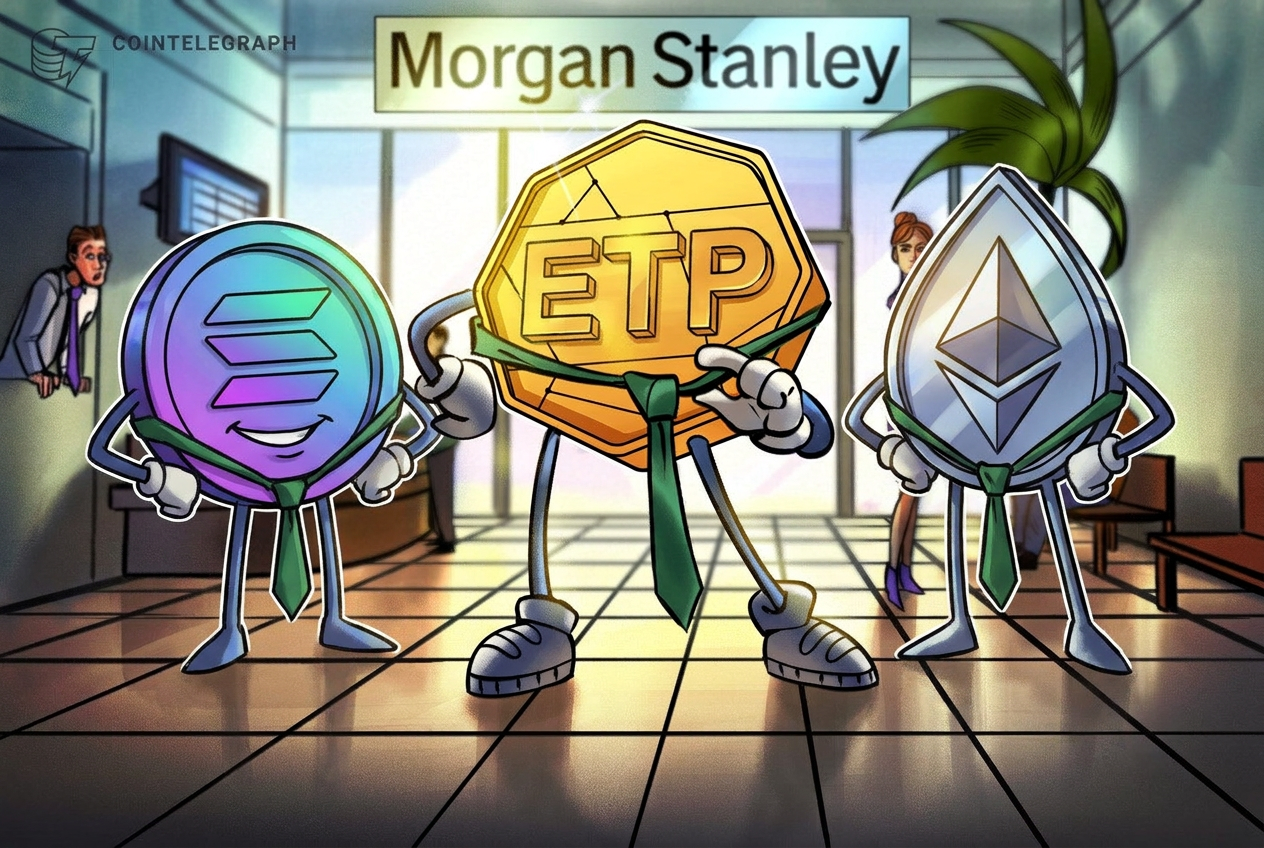
Morgan Stanley, a titan in the traditional finance landscape, has reportedly expanded its cryptocurrency offerings, introducing new exchange-traded products (ETPs) that track Ether (ETH) and Solana (SOL). This move follows the firm's earlier foray into the crypto market with a Bitcoin ETP launched earlier this year. The introduction of these new products signifies a growing acceptance and integration of digital assets within established financial institutions.
These ETPs are not merely passively tracking the price of the underlying cryptocurrencies; they are also designed to offer staking rewards. Staking, a core mechanism in proof-of-stake blockchains like Ethereum (post-Merge) and Solana, allows holders to earn passive income by participating in the network's validation process. Incorporating staking rewards directly into an ETP structure could make these products particularly attractive to a broader range of investors.
The expansion by a major player like Morgan Stanley into a wider array of digital assets beyond just Bitcoin suggests a maturing market and increasing institutional confidence. While Bitcoin often served as the initial entry point for traditional financial organisations, the inclusion of Ether and Solana indicates a recognition of the broader ecosystem's value and potential. These assets represent significant portions of the total cryptocurrency market capitalisation and underpin numerous decentralised applications and protocols.
Why it matters for Australian investors
For Australian investors, the expansion of Morgan Stanley's crypto ETPs carries several implications. Firstly, it signals a global trend towards greater institutional adoption of cryptocurrencies, which can influence local market sentiment and investment strategies. While these specific ETPs might not be directly available on Australian exchanges due to regulatory differences, their existence in major financial hubs often precedes similar offerings or increased liquidity in the Australian market.
Australian investors currently have options for gaining exposure to crypto assets through local exchanges like CoinSpot, Independent Reserve, Swyftx, and BTC Markets. These platforms facilitate direct purchases of cryptocurrencies, but regulated ETPs offer a different investment vehicle, often preferred by those who wish to invest through traditional brokerage accounts. The availability of such products overseas can put pressure on Australian regulators to consider similar frameworks that cater to institutional and retail investors seeking regulated crypto exposure.
Furthermore, the inclusion of staking rewards within these ETPs is a noteworthy development. For Australian investors, the tax treatment of staking rewards is a pertinent consideration, with the Australian Taxation Office (ATO) generally deeming them as ordinary income at the time of receipt. Regulated products offering such features demonstrate a pathway for investors to potentially earn yield on their crypto holdings within a more familiar financial structure, though local tax implications would always need to be carefully considered.
Impact on the AUD market
While Morgan Stanley's ETPs are not AUD-denominated or directly traded on the ASX, their launch contributes to the overall normalisation and legitimisation of cryptocurrencies as an asset class. This global institutional interest can indirectly influence the AUD-denominated crypto market by fostering increased liquidity and investor confidence. As more large players enter the space, even without direct local access, it can trickle down to affect perceived risk and investor behaviour in Australia.
Increased institutional engagement globally could also lead to a more stable and mature cryptocurrency market, which can be beneficial for Australian investors seeking exposure. A more robust global market, driven by traditional finance heavyweights, often translates to reduced volatility over the long term, making it a more appealing prospect for a wider range of Australian investors, from retail to sophisticated and wholesale investors.
The demand for Ether and Solana, as evidenced by these ETPs, could also influence the trading volumes and price action on Australian exchanges that list these assets. If global institutional demand strengthens, it may lead to higher prices or increased interest Down Under, affecting AUD trading pairs for ETH and SOL. Australian crypto exchanges are keenly observing these international developments for future product and service offerings aligned with local regulatory guidelines from ASIC and AUSTRAC.
What to watch next
Australian investors should closely monitor how the regulatory landscape evolves in response to these international developments. ASIC has been actively engaging with market participants regarding crypto-related products, and the precedent set by major global financial institutions could influence future policy decisions in Australia. The potential for locally accessible, regulated crypto ETPs, especially those incorporating features like staking, remains a key area of observation.
Further institutional entries into the crypto market, both in terms of new products and direct asset acquisition, will continue to shape the industry's trajectory. The move beyond Bitcoin to include significant altcoins like Ether and Solana suggests a broadening investment thesis within traditional finance firms. This trend could accelerate the development of more sophisticated financial instruments and services around a wider range of digital assets.
Investors should also pay attention to the performance and adoption rates of these new ETPs. Their success could encourage more traditional financial players to offer similar products, potentially paving the way for easier and more regulated access to crypto investments globally, and eventually in Australia. The interplay between traditional finance and decentralised finance will continue to be a dominant theme, offering both challenges and opportunities for the Australian investment community.
Coins covered




Common questions
Are Morgan Stanley's new Ether and Solana ETPs available to Australian investors?
Typically, ETPs launched overseas, especially those from large financial institutions like Morgan Stanley, are not directly available to Australian investors unless they are specifically listed on Australian stock exchanges (like the ASX) and comply with local regulatory frameworks established by bodies such as ASIC.
How does the ATO treat staking rewards from cryptocurrencies for Australian investors?
For Australian tax purposes, the Australian Taxation Office (ATO) generally considers staking rewards as ordinary income. The value of the rewards is usually calculated in Australian dollars at the time they are received by the investor, and this amount needs to be reported in your tax return. Specific circumstances can vary, so consulting a tax professional for personalised advice is always recommended.
What are the ways Australian investors can currently gain exposure to Ether and Solana?
Australian investors can gain exposure to Ether (ETH) and Solana (SOL) primarily through licensed Australian cryptocurrency exchanges such as CoinSpot, Independent Reserve, Swyftx, and BTC Markets. These platforms allow direct purchase and holding of these cryptocurrencies. While direct ETPs like Morgan Stanley's are not directly available in Australia, some global options may be accessible via international brokerage accounts, subject to investor eligibility and regulatory compliance.
Morgan Stanley expands crypto ETPs to Ether & Solana, including staking rewards. Discover what this means for Australian investors and the local AUD market.
About this article: this is an AI-generated summary of reporting by Cointelegraph. It has not been reviewed by a human editor. We use AI to localise crypto news for Australian readers, and we link back to the original source so you can verify the facts.
Informational only — not financial advice. Always do your own research. Read our AI & editorial policy →