
Mashinsky Moves to Vacate 12-Year Sentence as CFTC Greenlights 24/7 Crypto Perps and Wintermute Bridges Polymarket-Kalshi
AI-summarised from reporting by CoinOtag. How we use AI.
What happened
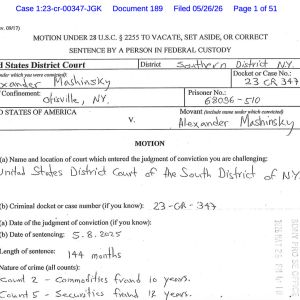
Recent filings in the US District Court for the Southern District of New York indicate that former Celsius CEO Alex Mashinsky has moved to vacate his 144-month sentence. This development unfolds as regulatory bodies in the United States, specifically the Commodity Futures Trading Commission (CFTC), have given the green light for certain platforms to offer 24/7 perpetual cryptocurrency futures trading. These perpetual futures are a type of derivative contract that allows traders to speculate on the future price of a cryptocurrency without an expiry date.
Simultaneously, a notable interoperability advancement has occurred in the decentralised finance (DeFi) space. Wintermute, a prominent crypto market maker, has reportedly facilitated a bridge between Polymarket and Kalshi. Polymarket is a decentralised prediction market platform, while Kalshi is a regulated event futures exchange. This bridging aims to enhance liquidity and expand the reach of prediction markets across different ecosystems.
These seemingly disparate events highlight the evolving and increasingly complex landscape of the global cryptocurrency market. From high-profile legal battles in the centralised finance sector to innovative advancements in decentralised trading derivatives, the industry remains in a constant state of flux. Australian investors often watch these international developments closely, as they can sometimes prefigure trends or regulatory approaches that might eventually impact the local market.
Why it matters for Australian investors
The ongoing legal proceedings involving figures like Alex Mashinsky underscore the significant regulatory scrutiny faced by centralised cryptocurrency entities globally. While Celsius did not have a direct retail presence as an ASIC-regulated entity in Australia, the collapse of such major international platforms can still ripple through investor confidence. Australian investors holding assets on various centralised exchanges or in lending protocols are keenly aware of the importance of robust compliance and transparency.
The approval of 24/7 crypto perpetual futures by the CFTC in the US is a particularly pertinent development. While Australian exchanges like CoinSpot, Independent Reserve, Swyftx, and BTC Markets primarily offer spot trading, the availability of more sophisticated derivative products internationally often prompts discussions within the Australian regulatory framework. AUSTRAC and ASIC maintain vigilance over financial products offered to Australian consumers, and any expansion of derivative offerings in other markets could inform their future considerations.
For Australian investors seeking diversification or more advanced trading strategies, access to such products might be through international platforms, which come with their own set of considerations, including foreign regulatory oversight and tax implications. The ATO's guidance on cryptocurrency taxation applies to profits from all digital asset activities, including derivatives, irrespective of where the trading occurs. Therefore, understanding the tax implications of international perpetual futures trading is crucial for Australian participants.
Impact on the AUD market
The machinations in the US regulatory and legal sphere, while not directly tied to the AUD's crypto-denominated value, do influence overall market sentiment. A more regulated and transparent global crypto environment, even if stemming from enforcement actions, can foster greater mainstream adoption and potentially stabilise market volatility. This, in turn, could indirectly benefit the broader crypto market, including AUD-pegged stablecoins and crypto assets traded against the Australian dollar.
The bridging efforts seen with Wintermute, Polymarket, and Kalshi, while highly technical, speak to the growing sophistication of the decentralised finance ecosystem. Increased interoperability and the potential for a wider array of decentralised financial instruments could eventually offer more options for Australian investors, albeit within the context of Australia's evolving DeFi regulatory discussions. For instance, the tokenisation of real-world assets or more complex DeFi products could become more accessible, changing how some Australian investors interact with digital assets.
However, it's important to remember that the Australian dollar's performance against major cryptocurrencies like Bitcoin and Ethereum is primarily influenced by global supply and demand dynamics, macroeconomic factors, and local investor sentiment towards digital assets. These international developments contribute to the global narrative but do not singularly dictate the AUD crypto market. The local market continues to mature with increasing institutional interest and ongoing regulatory dialogue from bodies like the Reserve Bank of Australia concerning digital currencies.
What to watch next
Australian investors should continue to monitor the outcome of high-profile legal cases like Mashinsky's. These cases set precedents for accountability in the centralised crypto space and can influence the regulatory approach to consumer protection globally. The Australian government and regulatory bodies, including ASIC, are keenly focused on ensuring market integrity and protecting consumers within the local digital asset sector.
Furthermore, the evolution of crypto derivatives markets, particularly in major jurisdictions like the US, will be a key area to observe. Whether and how these more complex financial products might eventually be offered or regulated for Australian investors will be a topic of ongoing discussion. AUSTRAC's role in monitoring transactions for financial crime risks will also remain paramount as the variety and volume of crypto activities grow.
Finally, continued innovations in interoperability and decentralised finance, such as the Wintermute bridge, signify a trend towards a more interconnected and potentially efficient crypto ecosystem. While these developments are often complex, they lay the groundwork for future financial products and services that could eventually become available to Australian participants. Staying informed about these technological advancements will be crucial for any Australian investor looking to understand the future trajectory of the digital asset market.
Coins covered



Common questions
How does the Mashinsky case affect Australian crypto holdings?
The Mashinsky case primarily involves the former CEO of a US-based centralised lending platform. While it doesn't directly affect crypto holdings on Australian exchanges like CoinSpot or Independent Reserve, such high-profile enforcement actions highlight the importance of due diligence and understanding the risks associated with centralised platforms, regardless of geographical location. It reinforces the need for robust regulatory oversight and transparency in the crypto sector globally.
Can Australian investors trade 24/7 crypto perpetual futures?
While the CFTC in the US has approved certain platforms to offer 24/7 crypto perpetual futures, the availability of these products to Australian investors depends on local regulations and the offerings of specific exchanges. Most ASIC-regulated Australian crypto exchanges primarily facilitate spot trading. Some Australian investors might access perpetual futures through international platforms, but they should be aware of the foreign regulatory environment, potential tax implications according to ATO guidelines, and generally increased risk associated with derivatives trading.
What is the Australian Tax Office's (ATO) stance on crypto derivatives like perpetual futures?
The ATO generally treats cryptocurrency as an asset for capital gains tax (CGT) purposes. This includes derivatives like perpetual futures. Any profit derived from trading these instruments, whether in AUD or other currencies, would likely be subject to CGT. It's crucial for Australian investors engaging in perpetual futures trading to keep meticulous records of their transactions and obtain professional tax advice to ensure compliance with ATO regulations.
Explore how former Celsius CEO's legal battle, US crypto derivatives approvals, and DeFi innovation impact Australian investors. CoinPulse AU analysis.
About this article: this is an AI-generated summary of reporting by CoinOtag. It has not been reviewed by a human editor. We use AI to localise crypto news for Australian readers, and we link back to the original source so you can verify the facts.
Informational only — not financial advice. Always do your own research. Read our AI & editorial policy →