
Here's why bitcoin bulls should take a closer look at interest rates
AI-summarised from reporting by CoinDesk. How we use AI.
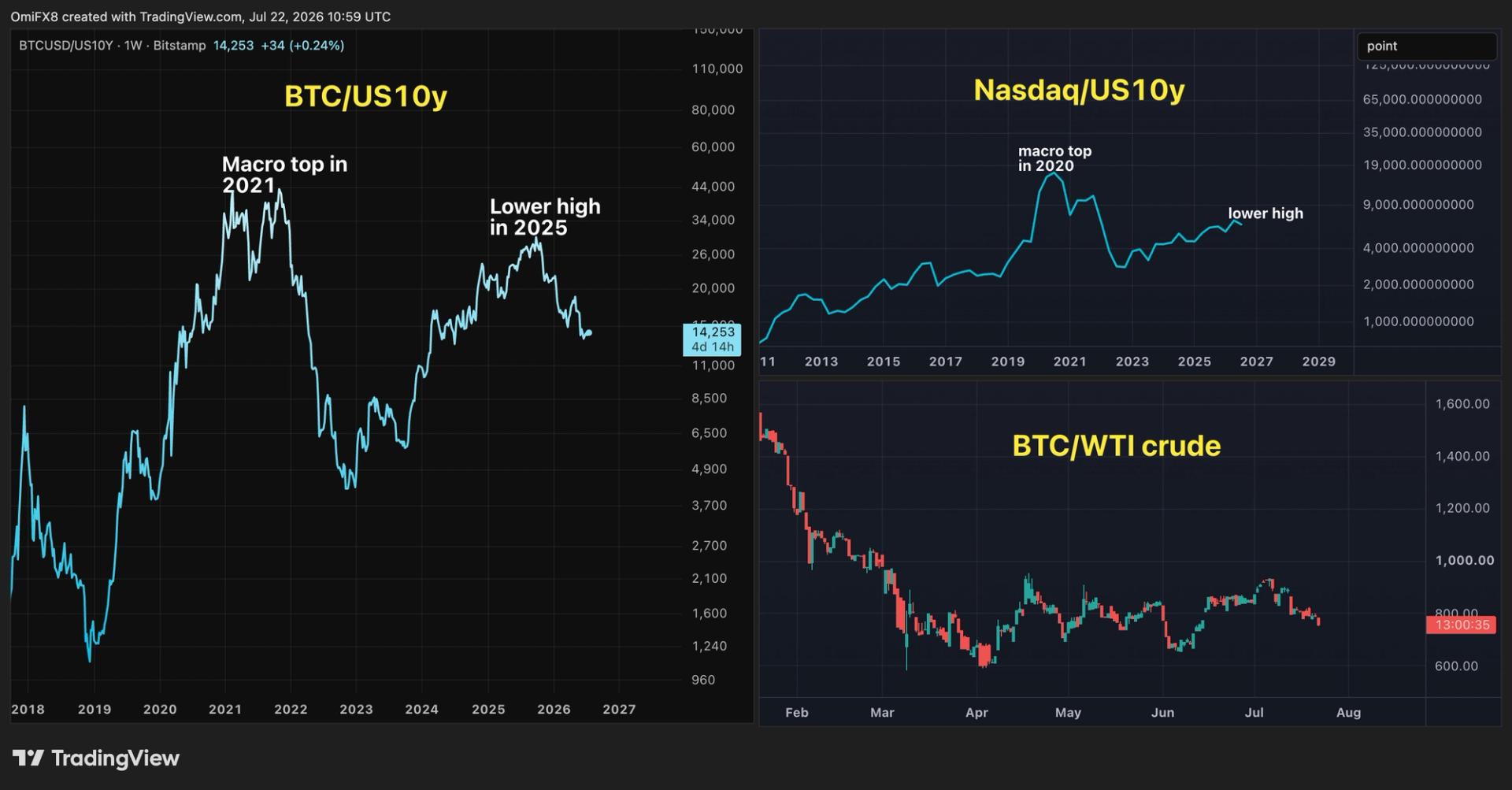
What happened
Bitcoin’s recent price movements have been increasingly influenced by macroeconomic factors, particularly global interest rate policies. Historically, digital assets like Bitcoin have often been perceived as uncorrelated to traditional finance. However, recent trends suggest a growing sensitivity to interest rate announcements and central bank hawkishness.
The global economic landscape is currently grappling with inflation, prompting many central banks, including the US Federal Reserve, to consider or implement interest rate hikes. These monetary policy shifts are designed to cool down overheating economies by making borrowing more expensive, thereby reducing consumer and business spending. This environment can have a ripple effect across all asset classes, including cryptocurrencies.
Rising interest rates typically increase the cost of capital, making riskier assets less attractive compared to safer, yield-bearing investments such as government bonds. For an asset like Bitcoin, which doesn't offer a traditional yield, this can translate into reduced demand from institutional investors and even some retail participants. The narrative that Bitcoin is an inflation hedge is also being tested, as its price has shown vulnerability during periods of high inflation coupled with aggressive rate hikes.
The market’s reaction to these macroeconomic signals has become more pronounced. Traders are now closely watching central bank meetings and inflation data releases, integrating these into their decision-making processes for Bitcoin and other cryptocurrencies. This indicates a maturing market where digital assets are becoming more integrated into the broader global financial system rather than operating in isolation.
Why it matters for Australian investors
Australian investors in the crypto space are not immune to these global macroeconomic shifts. The Reserve Bank of Australia (RBA) also monitors inflation and adjusts interest rates accordingly, and while its actions might be domestically focused, the broader global sentiment around rates heavily influences the AUD and investor risk appetite. High-profile RBA decisions on interest rates can indirectly impact the Australian dollar’s strength, which in turn affects the AUD-denominated price of Bitcoin and other crypto assets bought on local exchanges like CoinSpot, Independent Reserve, Swyftx, and BTC Markets.
When global interest rates rise, the appeal of 'risk-on' assets, including cryptocurrencies, can diminish for Australian institutions and sophisticated investors. These investors might reallocate capital towards less volatile, yield-generating investments in traditional financial markets. This capital flight could exert downward pressure on crypto prices, even if no direct Australian monetary policy changes are announced.
Furthermore, the Australian Taxation Office (ATO) treats cryptocurrency as property for capital gains tax purposes. Significant fluctuations in Bitcoin's price due to interest rate movements could lead to larger capital gains or losses, which Australian investors must accurately declare. Understanding the drivers behind these price shifts becomes crucial for sound financial planning and tax compliance.
Local exchanges play a vital role in connecting Australian investors to the global crypto market. While they facilitate AUD-to-crypto transactions, their liquidity and pricing dynamics are intrinsically linked to international trends. A global downturn in crypto demand stemming from interest rate concerns will inevitably be reflected in the pricing available on these platforms, directly affecting Australian portfolio values.
Impact on the AUD market
The Australian dollar (AUD) exchange rate is another critical factor for local crypto investors. When global interest rates, particularly in major economies like the US, rise faster than Australia's, it can strengthen the US dollar (USD) against the AUD. Since Bitcoin is globally priced predominantly in USD, a weaker AUD means Australian investors need more AUD to purchase the same amount of Bitcoin.
This currency dynamic adds an additional layer of complexity for Australian investors. Even if Bitcoin's USD price remains stable, a depreciation in the AUD can effectively make Bitcoin more expensive in local currency terms. Conversely, an appreciating AUD could make Bitcoin relatively cheaper for Australian buyers, assuming its USD price holds steady.
Australian regulated entities, overseen by organisations like AUSTRAC for anti-money laundering and counter-terrorism financing (AML/CTF) compliance, and ASIC for consumer protection, operate within this global and domestic financial context. Their oversight contributes to the market's integrity, but it doesn't shield investors from the volatility introduced by macroeconomic forces like interest rate changes. The regulatory environment is designed to manage risks associated with digital assets, but not to insulate against market price fluctuations driven by such pervasive economic factors.
The volume and liquidity on Australian crypto exchanges can also be influenced. If global investor sentiment turns bearish due to rising rates, a reduction in trading activity might be observed on platforms catering to the Australian market. This could potentially lead to wider bid-ask spreads or slower order execution during periods of high volatility, impacting cost-efficiency for local traders.
What to watch next
For Australian crypto investors, keeping a keen eye on global central bank announcements, especially from the US Federal Reserve and the European Central Bank, is paramount. Their decisions on interest rates and quantitative tightening or easing policies will continue to be significant drivers of Bitcoin's price direction. Monitoring global inflation data is equally important, as it often dictates the pace and intensity of central bank actions.
Domestically, the trajectory of the Reserve Bank of Australia’s monetary policy will also be relevant. While not directly dictating Bitcoin’s USD price, RBA decisions influence the AUD exchange rate, thereby affecting the local purchasing power and portfolio value for Australian holders. Local economic indicators, such as inflation figures and employment data, provide clues about the RBA's potential future moves.
Furthermore, observe how institutional adoption and investment flows into the crypto space react to these macroeconomic shifts. A sustained period of high interest rates could challenge the long-term capital allocation strategies of institutional players, potentially slowing down their entry into or expansion within the crypto market. Conversely, any signals of a pivot towards more accommodative monetary policies could reignite institutional interest.
Finally, the correlation between Bitcoin and traditional assets like equities should be monitored. There's an ongoing debate about whether Bitcoin is becoming more integrated with or decoupled from traditional finance. Interest rate changes often illuminate these correlations, providing valuable insights into Bitcoin’s evolving role in a diversified investment portfolio. For Australian investors, understanding these dynamics is key to navigating the volatile crypto landscape in the coming months.
Coins covered

Common questions
How do RBA interest rate changes affect my Bitcoin holdings on an Australian exchange?
While the RBA's interest rate decisions don't directly determine Bitcoin's global USD price, they can influence the AUD exchange rate. If the RBA raises rates and strengthens the AUD, Bitcoin might become relatively cheaper when purchased with Australian dollars (assuming its USD price is stable). Conversely, a weaker AUD due to RBA policy could make Bitcoin more expensive in local currency terms. These changes impact the AUD value of your crypto portfolio on local exchanges like CoinSpot or Swyftx.
Is Bitcoin considered an asset for capital gains tax by the ATO in Australia?
Yes, the Australian Taxation Office (ATO) treats cryptocurrency, including Bitcoin, as property for capital gains tax (CGT) purposes. This means that if you sell, trade, or otherwise dispose of your Bitcoin and realise a profit, you may be liable for CGT. It's crucial for Australian investors to keep accurate records of their crypto transactions to ensure compliance with ATO regulations.
Are Australian crypto exchanges like Independent Reserve regulated against global interest rate risks?
Australian crypto exchanges such as Independent Reserve are regulated by bodies like AUSTRAC for anti-money laundering (AML) and counter-terrorism financing (CTF) compliance, and in some aspects, by ASIC. However, this regulation focuses on operational integrity, consumer protection, and financial crime prevention, not on insulating investors from market price volatility or macroeconomic risks like interest rate fluctuations. Investors on these platforms are still exposed to global market dynamics.
Discover how global interest rates impact Bitcoin for Australian investors. Our analysis reveals why macroeconomic shifts are crucial for AUD crypto markets.
About this article: this is an AI-generated summary of reporting by CoinDesk. It has not been reviewed by a human editor. We use AI to localise crypto news for Australian readers, and we link back to the original source so you can verify the facts.
Informational only — not financial advice. Always do your own research. Read our AI & editorial policy →