
Ethereum Slips Below $1,900 as $1.84B Long Liquidation Sweeps Crypto Markets
AI-summarised from reporting by CoinOtag. How we use AI.
What happened
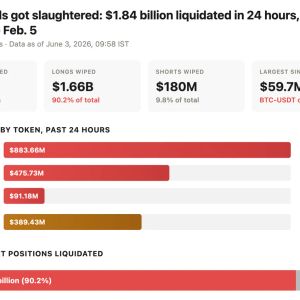
Crypto markets have recently experienced their most significant single-day liquidation event since early February, with approximately US$1.84 billion in leveraged positions being wiped out within a 24-hour period. This considerable market correction saw a broad sweep across the digital asset landscape, impacting numerous cryptocurrencies.
The primary catalyst for this massive liquidation appears to be a rapid downward movement in asset prices. For Australian investors, this meant seeing their portfolios affected by the broader market sentiment, even if denominated in AUD on local exchanges. The event highlights the inherent volatility of cryptocurrency markets, particularly for those engaging in leveraged trading activities.
Ethereum, a bellwether for the altcoin market, felt the brunt of this downturn, with its price temporarily slipping below the US$1,900 mark. This decline in Ethereum's value often has a ripple effect across other decentralised finance (DeFi) protocols and associated tokens, given its central role in the ecosystem. The sheer scale of liquidations underscores the high-risk nature of leveraged trading in such an environment.
The total value of liquidated positions reached an amount not seen in several months, indicating a substantial deleveraging across the market. This sort of event serves as a stark reminder of the interconnectedness of various crypto assets and the speed at which market dynamics can shift, affecting both long and short positions caught on the wrong side of the movement.
Why it matters for Australian investors
For Australian investors, such large-scale liquidations, even if originating predominantly in global markets, have direct implications. Prices on Australian exchanges like CoinSpot, Independent Reserve, Swyftx, and BTC Markets are closely tied to international market rates, adjusted for the AUD/USD exchange rate. A global price drop for Ethereum or Bitcoin will promptly translate into lower AUD prices for these assets on local platforms.
Beyond immediate price impacts, these events can influence investor sentiment within Australia. Periods of heightened volatility and significant price corrections can lead some retail investors to reconsider their participation, while others might view it as a buying opportunity. Understanding the underlying mechanics, such as leveraged liquidations, helps Australian investors contextualise market movements beyond simple price charts.
Furthermore, the Australian Taxation Office (ATO) classifies cryptocurrency as property for tax purposes. Substantial price movements and subsequent trading activity, whether buying the dip or exiting positions, have tax implications. Investors need to accurately track their cost bases and capital gains or losses, especially after significant market shifts, to ensure compliance with ATO guidelines.
This event also underscores the importance of risk management. For Australian investors using local or international platforms that offer leveraged trading, the risks associated with amplified gains and losses are profound. Even for those holding spot positions, understanding market behaviour driven by leveraged positions can provide crucial insights into potential volatility.
Impact on the AUD market
The immediate impact on the AUD market is primarily seen in the pricing of digital assets. When Ethereum, for instance, drops in USD value, its equivalent price in AUD on Australian exchanges will also decrease, assuming a stable AUD/USD exchange rate. This can lead to increased trading volumes on Australian platforms as investors react to the price changes.
While AUSTRAC (Australian Transaction Reports and Analysis Centre) primarily focuses on anti-money laundering and counter-terrorism financing, and ASIC (Australian Securities and Investments Commission) oversees financial services, significant market volatility can sometimes draw increased regulatory scrutiny. Although this particular event did not involve a specific Australian regulatory breach, large-scale market corrections are always monitored for systemic risks.
The AUD-denominated trading pairs for major cryptocurrencies, such as ETH/AUD or BTC/AUD, will reflect these global movements. Local liquidity providers and market makers on Australian exchanges will adjust their offerings to stay competitive with international rates. This ensures that Australian investors are generally trading at prices consistent with the global market, factoring in currency conversions.
Over the long term, recurring large liquidation events could subtly influence how Australian financial institutions and superannuation funds perceive crypto assets. While direct participation from these larger entities is still developing, sustained volatility might contribute to a cautious approach, even as they explore digital asset exposure.
What to watch next
Following such a substantial liquidation event, several factors will be crucial for Australian investors to monitor. Firstly, observing the market's recovery trajectory, particularly for Ethereum and other major altcoins, will indicate whether this was a temporary flush or the beginning of a more prolonged downturn. Technical indicators and on-chain metrics will provide further clues.
Secondly, global macroeconomic developments should always be on the radar. Broader economic trends, interest rate decisions by major central banks, and geopolitical events can all influence investor risk appetite, impacting cryptocurrency markets. Australian investors should be aware of how these global factors can translate into local market movements.
Thirdly, keep an eye on regulatory developments, both globally and locally. While this event was market-driven, ongoing discussions around stablecoin regulation, exchange oversight, and decentralised finance (DeFi) could introduce new parameters for crypto participation. Australian regulators like ASIC continue to watch this space closely.
Finally, observing funding rates on derivatives exchanges and the overall open interest will give an indication of whether speculative activity is rebuilding or if the market is maintaining a more conservative stance. A sustained period of lower leverage might signal a healthier, less volatile market environment in the short term, potentially offering clearer entry points for Australian investors.
Coins covered


Common questions
How do large crypto liquidations impact my crypto holdings on Australian exchanges?
When large liquidation events occur globally, they typically cause a sharp drop in cryptocurrency prices in USD. This directly translates to lower AUD prices on Australian exchanges like CoinSpot, Independent Reserve, Swyftx, and BTC Markets, affecting the AUD value of your holdings. Your portfolio's value will decrease in line with the market downturn, even if you are not engaging in leveraged trading yourself.
What Australian tax implications arise from crypto price drops and liquidations?
For Australian investors, any sale of cryptocurrency, regardless of whether it's at a profit or loss, is a capital gains tax event according to the ATO. If you sell your assets at a loss during a market downturn, you may be able to use those capital losses to offset capital gains in the same financial year or carry them forward to future years. It's crucial to keep accurate records of your purchases and sales to correctly calculate your tax obligations.
Should Australian investors be cautious about leveraged trading after such a large liquidation?
Yes, large-scale liquidation events underscore the extreme risks associated with leveraged trading in volatile cryptocurrency markets. While leverage can amplify gains, it can also lead to rapid and significant losses, often resulting in your entire collateral being wiped out. Australian investors considering leveraged products should ensure they fully understand the risks involved and ensure they have a robust risk management strategy in place, or consider sticking to spot trading which does not involve borrowed funds.
Australia reels as US$1.84B crypto liquidation hits markets. Learn what Ethereum's slip below US$1,900 means for Australian investors and the AUD market.
About this article: this is an AI-generated summary of reporting by CoinOtag. It has not been reviewed by a human editor. We use AI to localise crypto news for Australian readers, and we link back to the original source so you can verify the facts.
Informational only — not financial advice. Always do your own research. Read our AI & editorial policy →