
Ethereum Price Prediction: Will ETH Dump Toward $1K Next?
AI-summarised from reporting by Crypto Potato. How we use AI.
What happened
Ethereum (ETH) has recently entered a significant bearish phase, causing concern among global and Australian investors alike. The cryptocurrency has lost crucial high-timeframe support levels over a short period, pushing its price into a critical zone. This recent sell-off saw ETH break below a key confluence area that had previously acted as a strong support throughout the first half of the year.
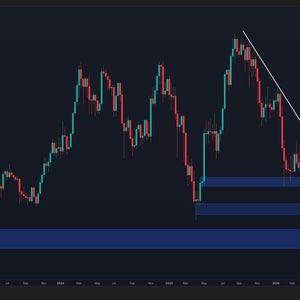
The weekly chart analysis reveals a notable deterioration in market structure. After peaking near $5,000, ETH has consistently formed lower highs beneath a descending trendline. This trendline has effectively capped all major recovery attempts since late 2025, solidifying bearish control and accelerating the recent downward price movement. This breakdown suggests a strong bearish continuation pattern, shifting focus to lower demand regions.
Critically, ETH has fallen below the significant support area of approximately $1,750-$1,850. This range was a pivotal point during the March rebound, and its failure to hold indicates continued selling pressure. The current weekly candle is testing the upper boundary of the next crucial demand zone, around $1,450-$1,550, with the price hovering near $1,560 at the time of analysis. A sustained weekly close beneath this region would significantly increase the likelihood of a deeper correction towards $1,150-$1,300, which represents the next major historical support level visible on the charts.
On a shorter timescale, the 4-hour chart underscores the severity of the sell-off. ETH broke down from a prolonged descending structure without establishing any meaningful support along the way. The blue support zone, roughly between $1,740 and $1,850, which also aligned with the 0.5-0.618 Fibonacci levels, failed to absorb selling pressure and has now transformed into a resistance area. While some reactive buying has been observed around the $1,500-$1,570 demand zone, this rebound is currently limited and does not signal a sustainable trend reversal. Should this support area fail, further downside below $1,500 could be expected. Conversely, any relief rally would likely encounter resistance at $1,740-$1,850, followed by a Fibonacci cluster between $1,880 and $1,920.
Why it matters for Australian investors
The current bearish turn for Ethereum holds significant implications for Australian investors, particularly those holding ETH or considering entry into the market. While the specific price points mentioned are in USD, the impact translates directly to the AUD equivalent on local exchanges like CoinSpot, Independent Reserve, Swyftx, and BTC Markets. A significant drop in ETH's USD value means a corresponding drop in its AUD value, affecting portfolio valuations.
Australian investors need to remain vigilant regarding market trends and potential price volatility. The Australian dollar's exchange rate against the US dollar can also amplify or mitigate these price movements. For instance, a weakening AUD against the USD alongside a falling ETH price would lead to a more substantial decline in an AUD-denominated portfolio.
Furthermore, the tax implications of cryptocurrency holdings in Australia, as set out by the Australian Taxation Office (ATO), remain a crucial consideration. Any buying or selling decisions made during volatile periods could trigger capital gains or losses. Investors should continue to track their cost bases carefully and understand the ATO's guidance on capital gains tax for digital assets.
The broader market sentiment, influenced by major assets like Ethereum, can also impact other altcoins popular among Australian investors. A sustained bearish trend in ETH could lead to a 'flight to quality' or a general reduction in risk appetite across the Australian crypto market, affecting liquidity and trading volumes on local platforms.
Impact on the AUD market
The recent downturn in Ethereum's price has a ripple effect on the Australian cryptocurrency market. As one of the largest and most influential cryptocurrencies, ETH's performance often acts as a barometer for broader market health. Local cryptocurrency exchanges in Australia, such as CoinSpot, Independent Reserve, and Swyftx, will reflect these price movements directly in their AUD pairing options.
While the source doesn't provide specific AUD-denominated figures or local market intelligence, the general market sentiment analysis is relevant. The 3-month liquidation heatmap, for instance, suggests that a substantial amount of downside liquidity was cleared as ETH plunged from above $2,000 towards $1,500. This action swept most of the notable liquidation clusters beneath the market, potentially reducing immediate magnetic pull from lower levels.
However, the most significant remaining liquidity concentrations are now positioned above the current price, particularly in the $1,700-$1,900 region and extending towards $2,400-$2,500. This creates an interesting dynamic where the market currently lacks major nearby liquidity targets below the spot price while maintaining sizeable overhead liquidation pools. For Australian traders, this means relief rallies could be met with strong selling pressure from these overhead liquidity zones, potentially limiting upside movement in AUD terms.
AUSTRAC, the Australian financial intelligence agency, and ASIC, the corporate regulator, maintain oversight of the Australian crypto landscape. While not directly influencing price, their regulatory environment contributes to the overall stability and investor confidence in the local market. Significant market volatility, even if stemming from global factors, can sometimes prompt closer scrutiny from these bodies regarding market conduct and consumer protection.
What to watch next
For Ethereum, and by extension, the broader Australian investor community, the immediate focus is on the $1,450-$1,550 support zone. The ability of ETH to stabilise within or above this region will be crucial. A weekly close below this level would significantly increase the probability of a more prolonged and deeper correction, potentially towards the $1,150-$1,300 historical demand area. Investors should monitor this range closely for signs of a bounce or a definitive break.
On the upside, bulls need to reclaim specific technical levels to indicate a shift in momentum. First, ETH would need to recover the broken $1,750-$1,850 region, which now acts as resistance. Following this, breaking above the descending trendline that has guided this bearish phase would be essential. Until these levels are decisively breached, the overall market structure for Ethereum remains bearish, signalling caution for those looking for a significant upturn.
The sentiment analysis suggests that while much of the immediate downside liquidity has been cleared, the absence of further significant liquidity below the current price doesn't automatically imply an immediate reversal. Instead, it hints at a potential period of consolidation or a corrective rebound before Ethereum establishes its next directional move. Australian investors should watch for sustained buying volume and clear breakouts from current ranges rather than short-lived rallies.
Furthermore, global macroeconomic factors and regulatory developments overseas will continue to play a role in cryptocurrency price action. Australian investors should keep an eye on broader market sentiment and any news that could influence the digital asset space, as these can easily override short-term technical indicators. Patience and a well-defined risk management strategy, accounting for both AUD-USD fluctuations and technical levels, will be paramount in navigating this uncertain period for Ethereum.
Coins covered



Common questions
How does Ethereum's price drop affect my crypto holdings on Australian exchanges?
When Ethereum's USD price drops, its Australian Dollar (AUD) equivalent on exchanges like CoinSpot, Independent Reserve, Swyftx, and BTC Markets will also decrease. This directly impacts the AUD value of your portfolio. The actual percentage change will be influenced by both the ETH/USD movement and the AUD/USD exchange rate.
What are the ATO tax implications for Australian investors if Ethereum's price falls?
If you sell Ethereum at a lower price than you bought it, you may incur a capital loss according to ATO guidelines. This loss can potentially be used to offset other capital gains. If you continue to hold, no taxable event occurs until you sell or dispose of your ETH. Accurate record-keeping of all transactions is vital for your tax obligations.
Should Australian investors be worried about AUSTRAC or ASIC due to this market volatility?
While AUSTRAC and ASIC primarily focus on regulatory compliance, consumer protection, and anti-money laundering (AML) measures rather than daily price movements, significant market volatility can sometimes draw their attention. They aim to ensure fair and orderly markets. As long as you are trading on regulated Australian platforms and adhering to KYC (Know Your Customer) requirements, the impact on individual investors from a regulatory perspective is generally minimal, but general market stability is always preferred.
Ethereum faces a critical bearish phase, losing key support levels. CoinPulse AU analyses what this means for Australian investors, AUD markets, and what to w
About this article: this is an AI-generated summary of reporting by Crypto Potato. It has not been reviewed by a human editor. We use AI to localise crypto news for Australian readers, and we link back to the original source so you can verify the facts.
Informational only — not financial advice. Always do your own research. Read our AI & editorial policy →