
CoinDesk 20 performance update: Stellar (XLM) jumps 10.5% as nearly all assets fall
AI-summarised from reporting by CoinDesk. How we use AI.
What happened
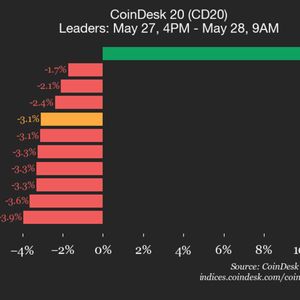
In a recent assessment of leading digital assets, the CoinDesk 20 index experienced a notable downturn, with the majority of its constituent cryptocurrencies recording declines. This broad market movement saw significant dips across various prominent projects, indicating a period of corrective action or increased market volatility. The overall trend reflected a challenging environment for many top-tier digital assets.
Among the assets experiencing the most significant drops were NEAR Protocol (NEAR) and Bitcoin Cash (BCH). NEAR Protocol saw its value decrease by 12.2%, positioning it as one of the hardest-hit assets within the index. Similarly, Bitcoin Cash (BCH) recorded a substantial 12.1% decline. These movements contributed significantly to the overall negative performance of the CoinDesk 20, pulling the index lower.
Amidst this general market contraction, one asset stood out with a positive performance: Stellar (XLM). While nearly all other assets in the index registered losses, Stellar (XLM) managed to buck the trend, achieving a 10.5% gain. This performance sets Stellar apart from the broader market movement, suggesting specific factors may have influenced its upward trajectory during a period of widespread decline.
Why it matters for Australian investors
For Australian investors, understanding these market movements is crucial for navigating their own digital asset portfolios. While the CoinDesk 20 is a global index, its constituent assets are readily available on Australian exchanges such as CoinSpot, Independent Reserve, Swyftx, and BTC Markets. Performance trends in major indices often influence sentiment and pricing in local markets, including the AUD-denominated pairs.
Periods of broad market decline, like the one observed, can present both challenges and potential opportunities. Investors may see their existing holdings in assets like NEAR Protocol and Bitcoin Cash experience depreciation in AUD terms. Conversely, the relative strength of an asset like Stellar (XLM) could draw attention from those seeking diversification or assets that demonstrate resilience.
Australian investors also need to consider the tax implications of their crypto holdings and activities. The Australian Taxation Office (ATO) views cryptocurrencies as property for capital gains tax (CGT) purposes. Any gains realised from selling, swapping, or gifting digital assets, even small amounts, must be declared. Losses can also be offset against gains, making detailed record-keeping essential.
Furthermore, the regulatory landscape in Australia, overseen by bodies like AUSTRAC for anti-money laundering and counter-terrorism financing (AML/CTF) and ASIC for consumer protection, continues to evolve. While these specific market movements aren't directly tied to new regulations, a more volatile market environment can underscore the importance of choosing reputable, AUSTRAC-registered exchanges and understanding the compliance frameworks they operate under.
Impact on the AUD market
The performance of major global cryptocurrencies inevitably cascades into the Australian dollar (AUD) market. When top assets like NEAR Protocol and Bitcoin Cash experience significant drops, their AUD trading pairs on local exchanges will reflect similar depreciation. This means an Australian investor holding these assets would see the AUD value of their portfolio diminish.
Conversely, Stellar's 10.5% jump could translate into a positive impact for Australian holders of XLM. An investor who holds Stellar (XLM) acquired in AUD, or who converts other assets into XLM, would see their investment appreciate in Australian dollar terms. This highlights how individual asset performance can diverge from the broader market, offering potential hedging or growth opportunities.
Volatility in the broader crypto market, as indicated by the CoinDesk 20's movement, often leads to increased trading activity on Australian platforms. Investors might rebalance portfolios, take profits, or look for entry points during dips. This increased activity can impact liquidity and order book depth on local exchanges, which can influence pricing for AUD pairs.
When global market sentiment turns negative, Australian investors might also consider stablescoins pegged to the AUD, if available on their preferred exchange, or even converting some crypto holdings back into fiat AUD to de-risk. However, such decisions should always align with individual financial goals and risk tolerance, without constituting financial advice.
What to watch next
Moving forward, Australian investors should closely monitor the broader market sentiment and the performance of key indices like the CoinDesk 20. Sustained periods of decline could signal further consolidation, while a rapid rebound might indicate underlying market strength. Keeping an eye on the leading indicators and major cryptocurrencies will be paramount.
Specific attention should be paid to the catalysts behind individual asset movements. For instance, understanding why Stellar (XLM) outperformed during a downturn could provide insights into its future trajectory. Are there upcoming network upgrades for Stellar, new partnerships, or increasing adoption that are driving this sustained positive momentum? Research into such factors is essential.
Furthermore, global macroeconomic conditions will continue to play a significant role. Inflation concerns, interest rate decisions by central banks globally, and geopolitical events can all influence investor appetite for risk assets, including cryptocurrencies. These macro trends often dictate the overarching direction of the market, including its impact on AUD-denominated crypto assets.
Finally, staying informed about regulatory developments within Australia is always prudent. While not directly tied to immediate price movements, potential changes from ASIC or AUSTRAC regarding investor protection, licensing requirements for exchanges, or the treatment of specific crypto products could influence local market dynamics and investor confidence. A well-informed approach, based on due diligence and a clear understanding of personal financial circumstances, remains critical for Australian investors in this dynamic landscape.
Coins covered




Common questions
How does ATO tax crypto gains from individual assets like Stellar or NEAR Protocol?
The ATO treats cryptocurrencies as property for capital gains tax (CGT) purposes. If you sell, swap, or gift assets like Stellar (XLM) or NEAR Protocol (NEAR) and realise a profit in Australian dollars, this is generally considered a capital gain and must be declared in your tax return. Records of purchase price, sale price, and transaction dates are crucial.
Can Australian investors buy NEAR Protocol or Bitcoin Cash on local exchanges?
Yes, many major Australian cryptocurrency exchanges, including CoinSpot, Independent Reserve, Swyftx, and BTC Markets, typically offer a range of prominent digital assets for trading. It is highly probable that NEAR Protocol and Bitcoin Cash would be available on at least some of these platforms, allowing Australian investors to buy and sell using AUD.
What does a 10.5% jump in Stellar (XLM) mean for its AUD price?
A 10.5% jump in Stellar (XLM) means its value has increased by that percentage against its primary trading pairs, often USD. For Australian investors, this would generally translate to a similar percentage increase in its AUD price on local exchanges, assuming the AUD/USD exchange rate remains relatively stable during that period. Your investment's AUD value would appreciate accordingly.
Discover why Stellar (XLM) soared amidst a CoinDesk 20 decline. A vital analysis for Australian investors on market shifts and AUD impact.
About this article: this is an AI-generated summary of reporting by CoinDesk. It has not been reviewed by a human editor. We use AI to localise crypto news for Australian readers, and we link back to the original source so you can verify the facts.
Informational only — not financial advice. Always do your own research. Read our AI & editorial policy →