
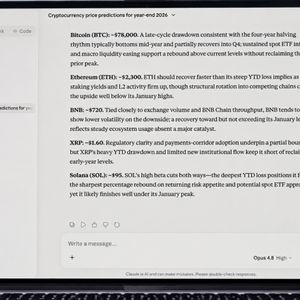
ChatGPT, Grok and Claude Predict Where Bitcoin, Ether, XRP and Solana Could Land by Dec. 31
AI-summarised from reporting by Bitcoin.com. How we use AI.
What happened
The cryptocurrency market has experienced a particularly challenging period throughout 2026, with the five largest digital assets by market capitalisation recording significant double-digit losses. This downturn has been widespread, impacting major players across the crypto landscape. Among these top five assets, Solana (SOL) has been hit the hardest, seeing its value diminish by over 47% since the beginning of the year. This substantial decline highlights a broader market struggle, affecting even well-established and widely adopted cryptocurrencies.
This trend of market contraction follows a period of heightened activity and investment, indicating a potential shift in investor sentiment or a broader economic recalibration. The year-to-date performance of these leading assets serves as a stark reminder of the inherent volatility within the crypto space. While specific catalysts for the declines were not detailed, the collective drop suggests a confluence of factors influencing market behaviour. This environment contrasts sharply with earlier periods of rapid expansion and demonstrates the dynamic nature of digital asset valuations.
Why it matters for Australian investors
For Australian investors, the performance of major cryptocurrencies like Bitcoin, Ether, XRP, and Solana is always a key indicator. These assets often set the tone for the wider market, influencing altcoin performance and overall market sentiment. A downturn in these leading assets can have a ripple effect, potentially impacting the value of diversified portfolios held by everyday Australians.
Australian crypto exchanges such as CoinSpot, Independent Reserve, Swyftx, and BTC Markets all offer access to these top-tier digital assets. Fluctuations in their value directly affect the AUD-denominated holdings of users on these platforms. Furthermore, the Australian Taxation Office (ATO) views cryptocurrencies as property for capital gains tax purposes, meaning any significant price movements can have implications for investors' tax obligations when they dispose of their assets, whether through sale, swap, or gift. Understanding these market dynamics is crucial for strategic portfolio management and compliant tax reporting within Australia.
Impact on the AUD market
The current market conditions, characterised by substantial price declines in major cryptocurrencies, inevitably have an impact on the Australian dollar (AUD) crypto market. When global crypto prices fall, the AUD value of assets held by Australian investors decreases proportionally. This can lead to reduced trading volumes on local exchanges as investors may adopt a 'wait and see' approach or shift capital to more stable assets.
Local exchanges facilitate the conversion of AUD into cryptocurrencies and vice versa. Significant market movements can influence investor behaviour, potentially leading to increased withdrawals of AUD if confidence wanes, or conversely, a surge in AUD deposits if investors see an opportunity to 'buy the dip'. However, Australian regulatory bodies like AUSTRAC continue to monitor transactions for financial crime risks, maintaining a focus on robust anti-money laundering (AML) and counter-terrorism financing (CTF) protocols regardless of market sentiment. ASIC also plays a role in consumer protection and market integrity, which remains vital during periods of market stress.
What to watch next
Looking ahead, Australian investors should closely monitor several key areas. The broader global economic climate will continue to exert influence on cryptocurrency markets. Macroeconomic indicators, interest rate decisions by central banks, and geopolitical events can all contribute to market sentiment and asset valuations. Any signs of stabilisation or recovery in traditional financial markets could potentially spill over into the crypto space, offering a much-needed boost.
Furthermore, regulatory developments both globally and within Australia are always critical to watch. Clarity on regulatory frameworks can provide certainty for institutional investors, potentially driving new capital into the market. Conversely, restrictive regulations could stifle growth. Technological advancements within the blockchain ecosystems of Bitcoin, Ether, XRP, and Solana, such as network upgrades or new use cases, will also be important drivers of future value. Australian investors should also keep an eye on trading volumes and liquidity on local exchanges, as these can be early indicators of changing market sentiment and investor participation.
Finally, observing the performance of these top-tier assets relative to the broader crypto market will provide insights into which segments are showing resilience or leading any potential recovery. A sustained shift in their trajectory could signal a change in the overall market environment. Diligence and an informed perspective remain paramount for navigating the ever-evolving cryptocurrency landscape for Australian investors.
Coins covered



Common questions
How does ATO tax crypto in Australia?
The Australian Taxation Office (ATO) generally treats cryptocurrency as property for capital gains tax (CGT) purposes. This means that when you dispose of your crypto – by selling it, swapping it for another crypto, or using it to buy goods or services – you may be liable for CGT on any profits made. Records of all transactions are crucial for accurate reporting.
Which crypto exchanges are popular in Australia?
Several cryptocurrency exchanges are popular among Australian investors, offering AUD deposits and withdrawals. Prominent examples include CoinSpot, Independent Reserve, Swyftx, and BTC Markets. These platforms cater to various investor needs, from beginners to experienced traders, providing access to a wide range of digital assets.
Is cryptocurrency regulated in Australia?
While there isn't a single comprehensive regulatory framework for all aspects of cryptocurrency in Australia, various laws and bodies provide oversight. AUSTRAC regulates crypto exchanges for anti-money laundering and counter-terrorism financing (AML/CTF) purposes. The ATO addresses the taxation of crypto, and ASIC focuses on consumer protection and market integrity in relation to crypto-related financial products or services.
Explore the challenging 2026 crypto market and its impact on Australian investors. Analyse Bitcoin, Ether, XRP, and Solana's performance from an AU perspectiv
About this article: this is an AI-generated summary of reporting by Bitcoin.com. It has not been reviewed by a human editor. We use AI to localise crypto news for Australian readers, and we link back to the original source so you can verify the facts.
Informational only — not financial advice. Always do your own research. Read our AI & editorial policy →