
Chainlink (LINK) And Pendle (PENDLE): As Tokenized Treasuries And Yield‑Trading Integrations Increase, Do LINK And PENDLE Anchor A “RWA + Rates” DeFi Stack Or S...
AI-summarised from reporting by Bitzo. How we use AI.
What happened
The cryptocurrency landscape is witnessing a significant shift, as institutional-grade Real-World Assets (RWAs) move beyond experimental stages into mainstream adoption. This evolving trend is largely fuelled by investors seeking stable yields amidst market volatility. Tokenised U.S. Treasuries, credit, and gold are increasingly converging with decentralised finance (DeFi), forming a new financial paradigm. At the heart of this convergence are two key protocols: Chainlink (LINK) and Pendle (PENDLE).
Chainlink acts as the essential data and interoperability layer, providing secure and reliable data feeds that are crucial for connecting real-world data with blockchain networks. Pendle, on the other hand, is a leading platform for yield tokenisation and the trading of forward rates within DeFi. Recent developments, such as Chainlink's CCIP extending to Solana via Kamino, and Pendle introducing substantial limit order incentives, indicate accelerating fundamental adoption for both protocols. However, despite these foundational advancements, the market pricing for LINK and PENDLE suggests they are still largely being viewed as specialist infrastructure plays rather than anchors of a dominant "RWA + Rates" DeFi stack.
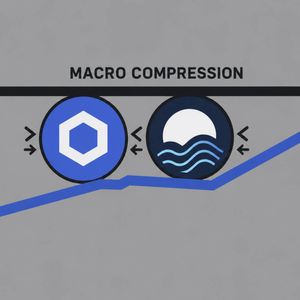
Chainlink's utility remains paramount in the RWA space, underpinning major initiatives like the DTCC's upcoming tokenised collateral platform and Fidelity International's tokenised USD liquidity fund. Despite such significant enterprise adoption, LINK's spot price has struggled to reflect this momentum. Over the past month, LINK has experienced considerable price compression, trading within a tight range near US$9.77. It has found immediate support around US$9.50 and faces resistance at US$10.25. Breaching this resistance and holding above the psychological US$10 mark is critical for LINK to signal broader market appreciation for its role in the RWA narrative.
Pendle is undergoing a substantial fundamental reorientation, transitioning to a new sPENDLE tokenomics model that allocates up to 80% of protocol revenue to structural buybacks. The protocol is also deepening integrations with Paxos RWA stablecoins and has secured a core collateral position on Aave V4. Despite these positive developments, PENDLE's token price has seen a significant drawdown, falling from a historical high of US$7.50 to the US$1.85 region. It recently experienced a sharp shakeout, briefly touching US$1.17 before attempting to establish a new accumulation base. Immediate support for PENDLE is around US$1.52, a level critical to defend to confirm a potential bottom. The next major resistance zone lies between US$2.80 and US$2.88, requiring a substantial rebound to escape its current "beaten-up beta" categorization.
Why it matters for Australian investors
For Australian investors, the expansion of RWA tokenisation presents a compelling opportunity to bridge traditional finance with the crypto ecosystem. Protocols like Chainlink and Pendle are foundational to this integration, offering exposure to the underlying infrastructure of a rapidly growing sector. The ability to tokenise assets such as US Treasuries means Australian investors could potentially access stable-yielding assets on-chain, diversifying their portfolios beyond traditional Australian equities or property. Monitoring the progress of these protocols could provide insights into future investment avenues that combine the transparency and efficiency of blockchain with the stability of established physical assets.
The regulatory landscape in Australia, overseen by bodies like ASIC and AUSTRAC, means that any entry into tokenised RWAs would need to navigate existing frameworks. While direct Australian tokenised treasury products are not yet widespread, understanding the global development, particularly in underlying infrastructure, is crucial. If these global trends gather pace, Australian exchanges such as CoinSpot, Independent Reserve, Swyftx, and BTC Markets could eventually facilitate access to such products, albeit with the usual investor safeguards and compliance considerations. The ATO's stance on tax treatment for crypto assets would also apply, making it important to track investments and potential capital gains.
Impact on the AUD market
While the immediate impact of Chainlink and Pendle's price movements on the broader Australian dollar (AUD) market is indirect, their foundational role in RWA tokenisation could have long-term implications. As global liquidity increasingly flows into tokenised assets, this could influence capital flows and investment sentiment. If, for instance, a significant portion of institutional capital globally migrates into tokenised US Treasuries, it could subtly shift demand dynamics for traditional fiat currencies. For Australian investors, this could mean new avenues to gain exposure to global treasuries or other assets in a tokenised form, potentially offering yield opportunities that might differ from those available in AUD-denominated traditional markets.
Furthermore, if tokenised RWAs gain widespread adoption globally, it could eventually lead to more sophisticated financial products being offered locally. This might include AUD-denominated tokenised assets, or even the tokenisation of Australian government bonds or credit. Such developments could introduce greater efficiency and liquidity into certain Australian financial markets, and potentially influence interest rate expectations or investment strategies among institutional players. However, these are longer-term considerations, and the current focus remains on the foundational infrastructure being built by protocols like Chainlink and Pendle on a global scale.
What to watch next
Investors focusing on the "RWA + Rates" narrative should closely monitor Chainlink's price action around its key support and resistance levels. A decisive break above US$10.25 and sustained trading above the US$10 psychological barrier would indicate a stronger market belief in its foundational role. Conversely, a fall below US$9.50 could signal further consolidation. Its ongoing enterprise integrations, particularly with major financial institutions, will be critical indicators of fundamental strength. Pay attention to any announcements regarding Chainlink's role in new institutional tokenisation projects globally.
For Pendle, the immediate focus is on its ability to defend the US$1.52 support level and establish a clear accumulation base. A sustained move towards and beyond the US$2.80 - US$2.88 resistance zone would be a significant positive signal, indicating that the market is beginning to re-rate its yield-trading capabilities. The success of its sPENDLE tokenomics model and its integrations with RWA stablecoins and DeFi lending protocols like Aave V4 will be crucial. Both protocols need to demonstrate sustained on-chain activity and increased user adoption to truly cement their position as core components of the burgeoning RWA and yield-trading ecosystem.
Coins covered
 View linkChainlinklinkLive price, charts & AUD analysis
 View pendlePendlependleLive price, charts & AUD analysis
 View solSolanasolLive price, charts & AUD analysis
 View aaveAaveaaveLive price, charts & AUD analysis
 View jstJUSTjstLive price, charts & AUD analysis
 View ondoOndoondoLive price, charts & AUD analysis
 View btcBitcoinbtcLive price, charts & AUD analysis
 View usdyOndo US Dollar YieldusdyLive price, charts & AUD analysis
Common questions
What is the Australian tax treatment for tokenised Real-World Assets (RWAs) if I invest through an Australian exchange?
The Australian Taxation Office (ATO) generally treats cryptocurrencies and tokenised assets as property for tax purposes. This means that capital gains tax (CGT) implications typically arise when you dispose of your tokenised RWAs, through selling, swapping, or gifting them. Investors should keep meticulous records of their transactions, including purchase price, date, and any disposal details, regardless of whether they transact on local exchanges like CoinSpot or Independent Reserve, or international platforms. Specific advice from a tax professional is always recommended.
Are there any specific Australian regulations or licenses required for platforms offering tokenised RWA products?
As the RWA market evolves, financial regulators like ASIC and AUSTRAC are closely monitoring developments. While specific licenses tailored solely for tokenised RWAs are still emerging, platforms offering such products to Australian users would likely fall under existing financial services licensing requirements (e.g., Australian Financial Services Licence - AFSL), especially if they involve regulated financial products, provide financial advice, or operate as a market facility. Anti-money laundering (AML) and counter-terrorism financing (CTF) obligations, enforced by AUSTRAC, would also apply to any platform handling these assets. Investors should ensure any platform they use is compliant with relevant Australian regulations.
How can Australian investors gain exposure to the RWA narrative if these products are primarily US-centric?
Australian investors can gain indirect exposure to the RWA narrative by investing in underlying infrastructure protocols like Chainlink (LINK) and Pendle (PENDLE) through various Australian-friendly cryptocurrency exchanges such as Swyftx, BTC Markets, or CoinSpot, which offer a range of digital assets. While direct AUD-denominated tokenised RWA products are still nascent, investing in the core technology that enables this market's growth allows participation. As the market matures, more direct access may become available through these or new platforms, potentially leveraging local partnerships or international product offerings that cater to Australian audiences.
Dive into Chainlink (LINK) & Pendle (PENDLE)'s role in tokenised Real-World Assets for Australian investors. Analysis of market dynamics & future outlook.
About this article: this is an AI-generated summary of reporting by Bitzo. It has not been reviewed by a human editor. We use AI to localise crypto news for Australian readers, and we link back to the original source so you can verify the facts.
Informational only — not financial advice. Always do your own research. Read our AI & editorial policy →