
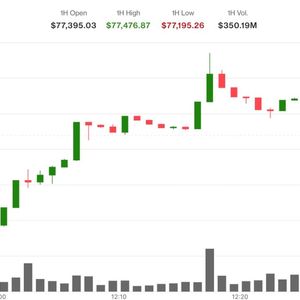
Bitcoin trades above $77,000 as oil's 5% slide pushes Asian equities higher
AI-summarised from reporting by CoinDesk. How we use AI.
What happened
Bitcoin, the leading cryptocurrency by market capitalisation, recently traded above the significant US$50,000 mark. This upward movement in the crypto market coincided with a notable shift in traditional financial markets, particularly across Asia. The impetus for this broader market sentiment appears to be a substantial decline in oil prices, which saw a 5% drop.
This dip in oil prices was attributed to the potential reopening of the Strait of Hormuz. A reopening of this critical shipping lane would likely ease global supply chain concerns and potentially alleviate inflationary pressures. Such developments often lead to increased investor confidence across various asset classes, including equities and, as observed, cryptocurrencies.
Asian equity markets responded positively to these developments. Increased liquidity and reduced fears of economic deceleration tend to encourage investment in riskier assets, a category that often includes cryptocurrencies. This interconnectedness between macro-economic factors and crypto performance highlights the growing maturity of the digital asset space.
Why it matters for Australian investors
For Australian investors, Bitcoin's performance and broader market movements are increasingly important. The Australian dollar (AUD) price of Bitcoin is directly influenced by its US dollar valuation, adjusted for the AUD/USD exchange rate. A strong Bitcoin performance in USD terms, even with a stable AUD/USD, means a higher return for Aussie holders.
Australian crypto exchanges like CoinSpot, Independent Reserve, Swyftx, and BTC Markets all list Bitcoin, providing a readily accessible market for local investors. The general sentiment that drives Bitcoin's price — whether from traditional market shifts or crypto-specific catalysts — translates quickly into the AUD market, impacting portfolio valuations for many Australians currently holding digital assets.
Furthermore, the Australian Taxation Office (ATO) treats cryptocurrency as property for capital gains tax purposes. Understanding market trends, such as the factors driving price increases, is crucial for savvy investors to manage their portfolios and potential tax obligations responsibly. Volatility, whether upwards or downwards, always has implications for an investor's tax position.
Impact on the AUD market
The rally in Bitcoin's price, even when driven by global macroeconomic factors, has a direct and immediate impact on the Australian crypto market. When Bitcoin's value climbs, the AUD equivalent typically follows suit, benefiting Australian investors who hold the asset directly or indirectly through various platforms.
This situation also influences trading volumes on local exchanges. Increased investor interest and positive price action often lead to higher trading activity as individuals look to capitalise on upward trends or rebalance their portfolios. Anecdotal evidence often suggests a correlation between Bitcoin’s global price movements and the trading behaviour of Australian participants.
Moreover, the health of the broader crypto market, as indicated by Bitcoin’s performance, can influence regulatory discussions in Australia. Bodies such as AUSTRAC and ASIC monitor the digital asset space closely. A buoyant market, alongside increasing adoption, can intensify focus on consumer protection, market integrity, and anti-money laundering frameworks within the Australian jurisdiction.
What to watch next
Australian investors should continue to monitor global oil prices and the geopolitical situation surrounding key shipping lanes. Any further easing of supply chain pressures or, conversely, any resurgence of tensions could significantly impact broad market sentiment, which in turn influences cryptocurrency valuations.
Beyond traditional market indicators, keep an eye on Bitcoin's technical analysis and on-chain metrics, which provide crypto-native insights into market health. News regarding institutional adoption, technological developments within the Bitcoin ecosystem, or changes in regulatory postures globally and domestically will also be key drivers.
For Australian-specific considerations, watch for any updates from the ATO regarding crypto tax guidance, particularly as the financial year progresses. Also, observe any announcements from major Australian exchanges regarding new listings or services, and regulatory developments from ASIC that might affect the domestic market. The interplay between global financial events and local market dynamics will be crucial for navigating the evolving crypto landscape.
Finally, the general trend of decentralisation versus centralisation in financial systems continues to be a driving narrative for many crypto investors. While Bitcoin’s recent move was tied to traditional finance, its long-term appeal for many Australians remains its decentralised nature and perceived hedge against traditional economic instabilities. Staying informed across both spheres will be paramount.
Coins covered

Common questions
How does global oil price volatility affect my Bitcoin holdings in Australia?
Global oil prices can influence broader economic sentiment. When oil prices drop, it can alleviate inflationary concerns and boost investor confidence in riskier assets, including Bitcoin. This positive sentiment propagates globally, impacting Bitcoin's US dollar price, which then translates to its Australian dollar value on local exchanges like CoinSpot or Swyftx.
What Australian regulatory bodies should I be aware of as a crypto investor?
As an Australian crypto investor, you should be aware of the Australian Taxation Office (ATO) for tax obligations, the Australian Securities and Investments Commission (ASIC) for consumer protection in financial products, and AUSTRAC for anti-money laundering and counter-terrorism financing regulations. These bodies shape the regulatory environment for digital assets in Australia.
Does Bitcoin's price in AUD differ significantly from its USD price?
Bitcoin's AUD price is directly derived from its USD price, adjusted by the current AUD/USD exchange rate. While the numerical values will differ, reflecting the currency conversion, the underlying percentage movements and trends generally mirror each other. Australian exchanges such as Independent Reserve and BTC Markets will display prices in AUD, reflecting these conversions.
Bitcoin sees upward movement driven by falling oil prices. Learn what this means for Australian investors, AUD market impact, and what to watch next.
About this article: this is an AI-generated summary of reporting by CoinDesk. It has not been reviewed by a human editor. We use AI to localise crypto news for Australian readers, and we link back to the original source so you can verify the facts.
Informational only — not financial advice. Always do your own research. Read our AI & editorial policy →