
Bitcoin supply in loss reaches record high 10.83 million BTC
AI-summarised from reporting by CoinDesk. How we use AI.
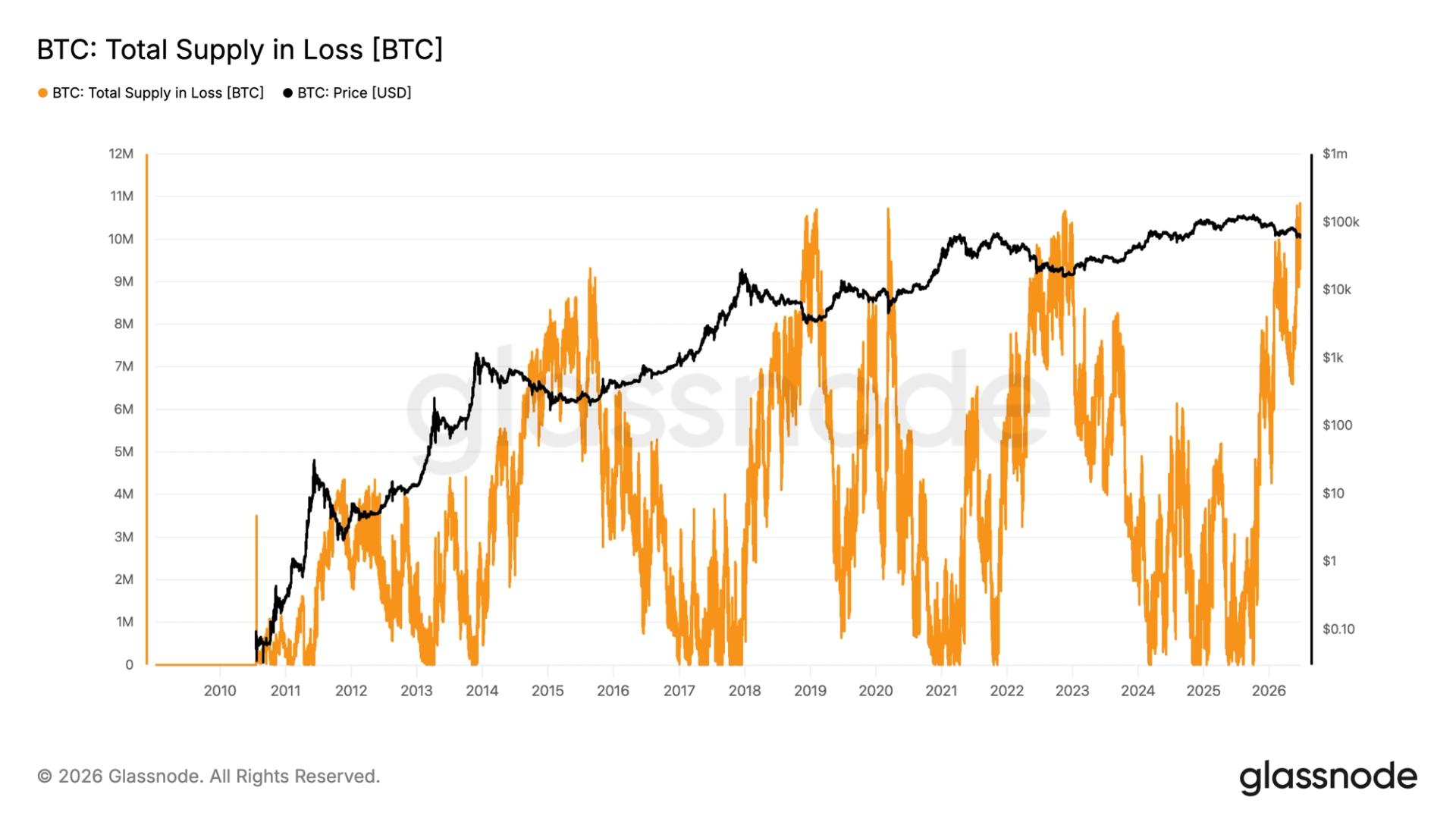
What happened
Recent on-chain data has revealed a significant shift in the Bitcoin market: a staggering 10.83 million BTC, representing over half of Bitcoin's circulating supply, is currently held at an unrealised loss. This means the current market price is below the price at which these coins were originally acquired. This metric, often overlooked, provides crucial insight into market sentiment and the distribution of wealth within the Bitcoin ecosystem.
Simultaneously, the data also highlights the steadfast conviction of a particular cohort within the Bitcoin community. Long-term holders, defined as addresses that have held their Bitcoin for an extended period, now control a record 14.8 million coins. This group typically comprises investors with a strong belief in Bitcoin's long-term value proposition, often weathering short-to-medium term price fluctuations without selling their assets. Their accumulated holdings suggest a continued HODLing mentality even in challenging market conditions.
The confluence of these two data points presents a complex picture. On one hand, a large portion of the market is underwater, indicating a period of price consolidation or decline that has left many recent entrants or less experienced traders facing losses. On the other, the growing accumulation by long-term holders suggests that sophisticated or conviction-driven investors view current prices as accumulation opportunities, anticipating future appreciation.
This dynamic is not uncommon in volatile asset classes like cryptocurrency. Periods of significant price corrections often 'flush out' less resilient holders, while simultaneously allowing those with a longer time horizon to increase their positions. Understanding these on-chain metrics can help investors gauge the underlying health and potential future trajectory of the market beyond daily price movements.
Why it matters for Australian investors
For Australian investors navigating the often-turbulent cryptocurrency landscape, these on-chain indicators offer valuable context. The fact that nearly 11 million BTC are held at a loss signals widespread market stress, which can translate into further volatility. Australian investors holding Bitcoin purchased at higher price points would currently be experiencing similar unrealised losses, impacting their portfolio valuations.
However, the record accumulation by long-term holders also sends a potentially reassuring signal. It suggests that despite broader market pain, a core group of seasoned investors remains committed to Bitcoin. This conviction can contribute to a more stable foundation for future price recovery, which is relevant for the long-term outlook of Australian portfolios.
Australian investors also need to remember the tax implications of their crypto holdings. The Australian Taxation Office (ATO) considers Bitcoin a capital gains tax (CGT) asset. While unrealised losses don't trigger a tax event, selling at a loss can be used to offset capital gains elsewhere, a strategy often employed during market downturns. Understanding these on-chain trends can help inform decisions about portfolio adjustments and tax planning.
Furthermore, the prevalence of major Australian crypto exchanges like CoinSpot, Independent Reserve, Swyftx, and BTC Markets means local investors have ready access to the market. Monitoring these global on-chain trends, combined with local market sentiment, is crucial for making informed investment decisions rather than reacting solely to short-term price movements displayed on these platforms.
Impact on the AUD market
The global sentiment reflected in these on-chain metrics inevitably trickles down to the Australian dollar (AUD) cryptocurrency market. While Bitcoin is a global asset, its price can still be influenced by local supply and demand dynamics, as well as the broader economic climate in Australia.
When a large proportion of global Bitcoin supply is in an unrealised loss position, it can contribute to a dampening effect on demand from new Australian buyers. Potential investors might be more cautious to enter a market where many existing holders are underwater, leading to slower adoption or reduced purchasing activity on AUD-denominated exchanges.
Conversely, the strong accumulation by long-term holders could indicate a belief in Bitcoin's eventual recovery, which might inspire confidence among some Australian investors. Those with a high-conviction ethos might view current AUD prices as an attractive entry point, particularly if they believe the market is nearing a bottom. This could see renewed buying pressure from this particular cohort of local investors.
The overall impact on AUD trading pairs for Bitcoin (BTC/AUD) would likely manifest as increased volatility and potentially sideways price action until a clearer global trend emerges. Australian investors transacting through AUSTRAC-registered exchanges are subject to robust regulatory oversight, ensuring a level of transparency and compliance that aids market stability, even during periods of global uncertainty in asset values.
What to watch next
Moving forward, Australian investors should closely monitor a few key indicators related to these on-chain trends. Firstly, observe whether the amount of Bitcoin held at an unrealised loss begins to decrease. A sustained reduction would suggest that prices are rising above previous acquisition costs, indicating a market recovery and potential alleviation of selling pressure.
Secondly, continue to track the behaviour of long-term holders. A continued increase in their holdings, especially during periods of market weakness, reinforces the narrative of strong underlying conviction. Conversely, if long-term holders begin to distribute their coins, it could signal a shift in their outlook and potentially foreshadow further price corrections.
Pay attention to the average 'cost basis' of the total Bitcoin supply. As the market evolves, understanding where the largest concentrations of investors bought their BTC can help identify key support and resistance levels. For Australian investors, this global average provides a benchmark against which to assess their own portfolio's performance.
Finally, keep an eye on broader macroeconomic factors, both globally and locally. Inflation, interest rates, and regulatory developments (from bodies like ASIC or the ATO) can all influence investor sentiment and impact Bitcoin's price trajectory. These external factors, combined with the on-chain metrics, will provide a comprehensive view for making informed investment decisions in the Australian crypto market.
Coins covered

Common questions
What does it mean if Bitcoin supply is 'in loss' for Australian crypto owners?
For Australian crypto owners, if a significant portion of Bitcoin's supply is 'in loss', it means that most people who bought Bitcoin are currently holding it at a price lower than their original purchase price. This indicates a general market downturn, and if you bought Bitcoin at a higher price, your investment would also be showing an unrealised loss in AUD terms.
How does the record high of long-term Bitcoin holders affect my investment on Australian platforms?
A record high number of long-term Bitcoin holders suggests that a strong cohort of investors believes in Bitcoin's future value, despite current market conditions. While it doesn't directly impact daily AUD prices on Australian platforms like CoinSpot or Swyftx, this underlying conviction can contribute to market stability and potential long-term price appreciation, influencing your investment's future value.
Do unrealised losses on Bitcoin affect my ATO tax obligations in Australia?
Unrealised losses on your Bitcoin holdings do not trigger an immediate tax event or obligation with the ATO. Capital gains tax (CGT) only applies when you 'dispose' of your Bitcoin, for example, by selling it for AUD, trading it for another cryptocurrency, or using it to pay for goods or services. However, if you sell Bitcoin at a loss, you can use that capital loss to offset other capital gains, which can impact your overall tax position.
Explore why 10.83 million BTC held at a loss and record long-term holders matter for Australian investors. Get expert analysis from CoinPulse AU.
About this article: this is an AI-generated summary of reporting by CoinDesk. It has not been reviewed by a human editor. We use AI to localise crypto news for Australian readers, and we link back to the original source so you can verify the facts.
Informational only — not financial advice. Always do your own research. Read our AI & editorial policy →