
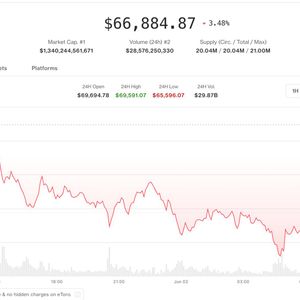
Bitcoin steadies at $67,000, faces critical juncture after sliding 9.5% in seven days
AI-summarised from reporting by CoinDesk. How we use AI.
What happened
Bitcoin (BTC) has recently experienced a significant downturn, witnessing a 9.5% decline over the past seven days. This slide brought its price down to approximately US$67,000, a critical juncture for the world's leading cryptocurrency. The market correction occurred despite a broader rally in traditional US stock markets, which have been hitting record highs, and a surge in the performance of artificial intelligence (AI) related tokens. This divergence suggests that macro-economic factors influencing traditional equities are not directly translating into positive momentum for Bitcoin at this time.
Several factors appear to be contributing to Bitcoin's recent volatility. Notably, the market has seen a surge in interest surrounding 'AI tokens', which have captured investor attention. Additionally, a significant development involving Coinbase and Ethena has garnered considerable spotlight. While the specifics of this deal were not detailed, its prominence suggests a notable shift in market dynamics and investor focus, potentially drawing capital away from Bitcoin in the short term. These elements collectively paint a picture of a crypto landscape undergoing re-evaluation, with capital flows shifting towards emerging narratives and platforms.
The 9.5% weekly drop for BTC represents a notable psychological and technical level for investors. Such a decline in a relatively short period can trigger selling pressure as some investors opt to de-risk or rebalance their portfolios. The US$67,000 mark is often viewed as a key support or resistance level by technical analysts, meaning that sustained trading below this point could signal further bearish sentiment, while a recovery above it could indicate renewed buyer confidence. The cryptocurrency market remains highly sensitive to major news and broader economic trends, making such price movements common but always significant.
Why it matters for Australian investors
For Australian investors, Bitcoin's recent price action is particularly relevant. While priced in US dollars globally, the equivalent AUD value of Bitcoin on Australian exchanges like CoinSpot, Independent Reserve, Swyftx, and BTC Markets directly fluctuates with these international movements. A depreciation in BTC's USD value, even if the Australian dollar strengthens against the USD, generally translates to a lower AUD value for their holdings. This directly impacts portfolio valuations and potential capital gains or losses for Australian crypto participants.
Australian investors also need to consider the tax implications of such market movements. The Australian Taxation Office (ATO) treats cryptocurrency as a form of property for capital gains tax (CGT) purposes. A sale of Bitcoin, whether for profit or loss, must be declared in income tax returns. A 9.5% weekly decline could lead some Australian investors to harvest losses for tax purposes, offsetting other capital gains. Understanding these rules is crucial, especially during periods of high volatility, to manage tax obligations effectively.
The broader sentiment driven by Bitcoin’s performance can also influence the Australian crypto market. While specific AI tokens or the Ethena deal might not directly involve Australian entities, the overall shift in global crypto narratives can impact investment decisions locally. Australian crypto exchanges and service providers operate within a regulatory framework overseen by AUSTRAC for anti-money laundering (AML) and counter-terrorism financing (CTF) purposes, and ASIC has a watchful eye on various aspects of the digital asset space. Sustained market downturns or significant shifts in investor interest can lead to decreased trading volumes and activity on these platforms, affecting their business models and the broader Australian crypto ecosystem.
Impact on the AUD market
The direct impact of Bitcoin’s 9.5% weekly slide on the Australian dollar (AUD) market is typically nuanced. While Bitcoin's market capitalisation is substantial, it does not exert the same direct influence on the AUD as major commodities like iron ore or global interest rate differentials. However, a significant downturn in Bitcoin can reflect broader risk-off sentiment in global markets, which can indirectly affect the AUD. During periods of heightened risk aversion, investors often flock to safe-haven assets, potentially putting pressure on riskier currencies like the AUD.
Furthermore, the flow of capital into and out of cryptocurrencies by Australian investors can have a marginal but observable effect. When Australian investors liquidate Bitcoin holdings, they often convert these back into AUD, or potentially into other assets. While the scale of these conversions might not move the needle for the entire AUD forex market, it contributes to overall market liquidity and investor behaviour. Crypto-native businesses in Australia, which often hold a mix of crypto and AUD assets, could also experience balance sheet adjustments during significant price swings.
The psychological impact on Australian investors' confidence in digital assets is also noteworthy. A sustained downturn in Bitcoin might lead to a more cautious approach to crypto investments among Australians, potentially slowing the growth of the local digital asset sector. This sentiment can filter through to local crypto service providers and start-ups, affecting funding and expansion plans. Regulatory bodies like ASIC continue to monitor market trends, and significant volatility could influence their approach to investor protection and market integrity within the Australian context.
What to watch next
Moving forward, Australian investors should closely monitor Bitcoin's price action around key technical levels. Its ability to reclaim and sustain above the US$67,000 mark will be a significant indicator of short-term market health. A failure to do so, or a further decline, could suggest continued downward pressure. Keeping an eye on the broader market sentiment, particularly the performance of traditional assets and the continued rally in AI tokens, will also provide valuable context. The rotation of capital between different asset classes is a key dynamic to observe.
Furthermore, developments surrounding significant industry players and emerging narratives, such as the Coinbase-Ethena deal, could continue to influence market flows. These events can signal shifts in institutional interest or new trends that capture investor attention globally. Australian investors would be wise to track these global developments, as they often precede similar movements in the local market, albeit with some lag.
Regulatory environments, both internationally and domestically, also remain a critical watch point. Any new guidance from bodies like AUSTRAC or ASIC regarding crypto assets, particularly around taxation or consumer protection, could impact the landscape for Australian investors. Global regulatory changes, especially those from major jurisdictions, can have ripple effects worldwide. Staying informed on these fronts will be essential for navigating the evolving digital asset space in Australia.
Lastly, the interplay between the Australian dollar's strength and Bitcoin's USD price will always be a factor for local investors. A strengthening AUD can partially cushion the impact of a Bitcoin price drop when converting back to local currency, and vice versa. Monitoring currency exchange rates alongside crypto prices provides a more complete picture of actual asset performance for Australians.
Coins covered


Common questions
How does Bitcoin's price impact my AUD crypto holdings on Australian exchanges?
When Bitcoin's USD price falls, its AUD equivalent on Australian exchanges like CoinSpot or Swyftx will also decrease as the exchange rate is applied. This directly affects the value of your holdings in Australian dollars, regardless of whether you've converted them back to AUD yet.
What are the ATO tax implications for Australian investors if Bitcoin drops in value?
If Bitcoin drops in value and you sell it for less than you bought it, you realise a capital loss. The ATO allows Australian investors to use capital losses to offset other capital gains from crypto or other assets, which can help reduce your overall tax liability. It's crucial to keep accurate records of all your crypto transactions.
Are Australian crypto exchanges like Independent Reserve or BTC Markets affected by global Bitcoin price movements?
Yes, Australian crypto exchanges are directly affected by global Bitcoin price movements. While they operate within Australia, their pricing for Bitcoin is heavily influenced by international market rates. A significant global price change in Bitcoin will be reflected almost immediately in the AUD prices offered on platforms like Independent Reserve and BTC Markets.
Bitcoin's recent 9.5% slide to US$67,000 presents a critical juncture. CoinPulse AU analyses what this means for Australian investors, tax implications, and t
About this article: this is an AI-generated summary of reporting by CoinDesk. It has not been reviewed by a human editor. We use AI to localise crypto news for Australian readers, and we link back to the original source so you can verify the facts.
Informational only — not financial advice. Always do your own research. Read our AI & editorial policy →