
Bitcoin’s calm is back and so is the setup for a volatility explosion
AI-summarised from reporting by CoinDesk. How we use AI.
What happened
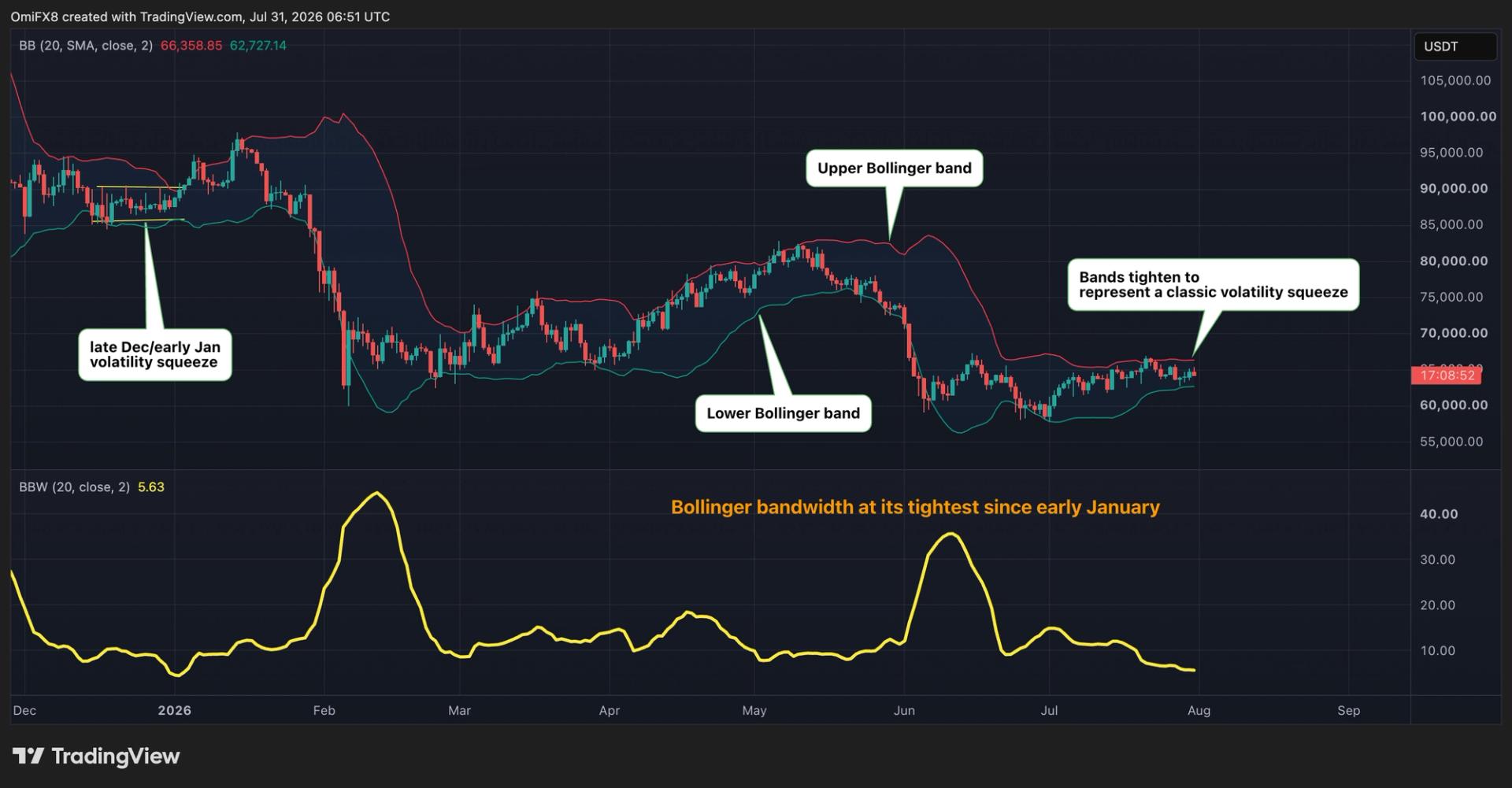
Bitcoin’s characteristic volatility, a defining feature for much of its existence, has recently taken a back seat. The cryptocurrency has experienced a significant tightening of its daily price swings, reaching levels not seen since January of this year. This period of unusual calm has led to a market environment where clear trading signals are much harder to identify.
While some might interpret reduced volatility as a sign of maturity or stability, in the world of Bitcoin, it often presages a substantial price movement. Historically, extended periods of low volatility in Bitcoin have been followed by explosive upward or downward shifts. This current lull is therefore being keenly watched by analysts and investors alike, as it suggests a significant move could be on the horizon.
This phenomenon isn't new to cryptocurrency markets. Bitcoin has a well-documented history of these 'volatility compression' phases, which are typically resolved by a sharp breakout from the established trading range. The question now isn't if the volatility will return, but rather when, and in which direction the market will ultimately move.
The current market composure, while potentially frustrating for day traders seeking rapid gains, offers a moment for investors to reassess their positions and strategies. It highlights the inherent cyclical nature of Bitcoin's price action and reinforces the belief that periods of calm are often just the prelude to more dynamic times.
Why it matters for Australian investors
Australian investors, like their global counterparts, operate within a market where Bitcoin's price discovery is truly global. The current low volatility means that the opportunities for quick gains from short-term price swings on platforms like CoinSpot, Independent Reserve, Swyftx, or BTC Markets are diminished. However, it also presents a potential accumulation phase for those bullish on Bitcoin's long-term prospects.
For Australians considering entering or expanding their crypto portfolios, understanding this dynamic is crucial. A sudden return of volatility could lead to significant price dislocations, impacting the value of their holdings in Australian dollar terms. This makes risk management and a clear investment thesis more important than ever.
Furthermore, the Australian Taxation Office (ATO) treats cryptocurrency as property for tax purposes, meaning capital gains tax applies to profits from selling or exchanging Bitcoin. A volatility explosion, leading to substantial gains (or losses), would have direct implications for an investor's tax obligations. Understanding how to manage these tax implications in a highly volatile market is a key consideration for Australian investors.
The regulatory landscape in Australia, overseen by bodies like AUSTRAC for anti-money laundering and ASIC for investor protection in other financial products, doesn't directly dictate Bitcoin's price volatility. However, a stable and transparent regulatory environment fosters confidence. As the market matures, clarity on issues like consumer protection and exchange oversight could indirectly influence sentiment around Bitcoin, even amidst global price swings.
Impact on the AUD market
While Bitcoin's price is predominantly driven by global supply and demand dynamics, its fluctuation directly impacts the Australian dollar value for local investors. A significant price movement in Bitcoin, whether up or down, will immediately translate into a corresponding change in the AUD value of an investor's holdings.
For instance, if Bitcoin experiences an upward volatility explosion, Australian investors holding Bitcoin will see the AUD value of their assets appreciate substantially. Conversely, a downward spiral would lead to a depreciation. This direct correlation means that Australian investors need to monitor not only Bitcoin's price in USD but also the AUD/USD exchange rate, as both factors influence their ultimate returns.
Local cryptocurrency exchanges, such as CoinSpot and Independent Reserve, predominantly list Bitcoin against the Australian dollar. A period of high volatility will therefore be reflected immediately in the AUD-denominated order books and trading pairs offered by these platforms. This makes risk management for AUD-denominated crypto portfolios particularly pertinent during such times.
Moreover, the ease of converting AUD to Bitcoin and vice versa on these exchanges means that a rapid price change can trigger increased trading activity. Australian investors, therefore, are directly exposed to the financial implications of any upcoming volatility explosion, both in terms of potential gains and losses on their investments.
What to watch next
The crucial question for investors now is what will trigger the next volatility explosion and in which direction will Bitcoin move. Analysts are closely monitoring a range of technical indicators and on-chain metrics for signs of an impending breakout. Volume trends, funding rates, and open interest in derivatives markets can often provide clues regarding market sentiment and potential directional biases.
Key macroeconomic factors continue to play a significant role. Global interest rate decisions, inflation data, and broader market sentiment towards risk assets will all influence Bitcoin's trajectory. Any surprising developments in these areas could easily serve as a catalyst for a sudden price movement, breaking the current calm.
Furthermore, regulatory developments globally, and specifically any new guidance from Australian bodies like ASIC or AUSTRAC, could also impact sentiment. While not direct price drivers, clear regulatory frameworks can foster institutional adoption or, conversely, create headwinds depending on their nature.
For Australian investors, keeping abreast of both global crypto news and local economic indicators is vital. Given Bitcoin's history, the current period of low volatility is highly unlikely to last. Preparing for a sharp move, in either direction, by having a clear strategy and understanding one's risk tolerance, will be paramount in navigating the next phase of Bitcoin’s price action.
Coins covered


Common questions
What does Bitcoin's low volatility mean for my Australian crypto portfolio?
Low volatility means Bitcoin's price isn't swinging much in Australian dollar terms, making rapid short-term gains harder. However, history suggests this calm often precedes a large price move, offering a potential accumulation phase for long-term holders before the next big shift.
How does the ATO's tax treatment of crypto affect me during a volatility explosion?
The ATO treats cryptocurrency as property, meaning selling or exchanging Bitcoin for a profit triggers capital gains tax. A sudden volatility explosion could lead to significant gains (or losses), directly impacting your tax obligations. It's crucial to track all transactions for tax purposes.
Which Australian crypto exchanges are affected by Bitcoin's volatility?
All Australian crypto exchanges that list Bitcoin, such as CoinSpot, Independent Reserve, Swyftx, and BTC Markets, are directly affected. Their AUD-denominated trading pairs will reflect any rapid price changes, meaning your AUD holdings and trading opportunities are immediately impacted.
Bitcoin's unusual calm suggests a major price move is coming. Australian investors: understand impacts on your AUD investments and tax implications.
About this article: this is an AI-generated summary of reporting by CoinDesk. It has not been reviewed by a human editor. We use AI to localise crypto news for Australian readers, and we link back to the original source so you can verify the facts.
Informational only — not financial advice. Always do your own research. Read our AI & editorial policy →