
Bitcoin pulls back to $64,000 after hitting monthly high as bears take control
AI-summarised from reporting by CoinDesk. How we use AI.
What happened
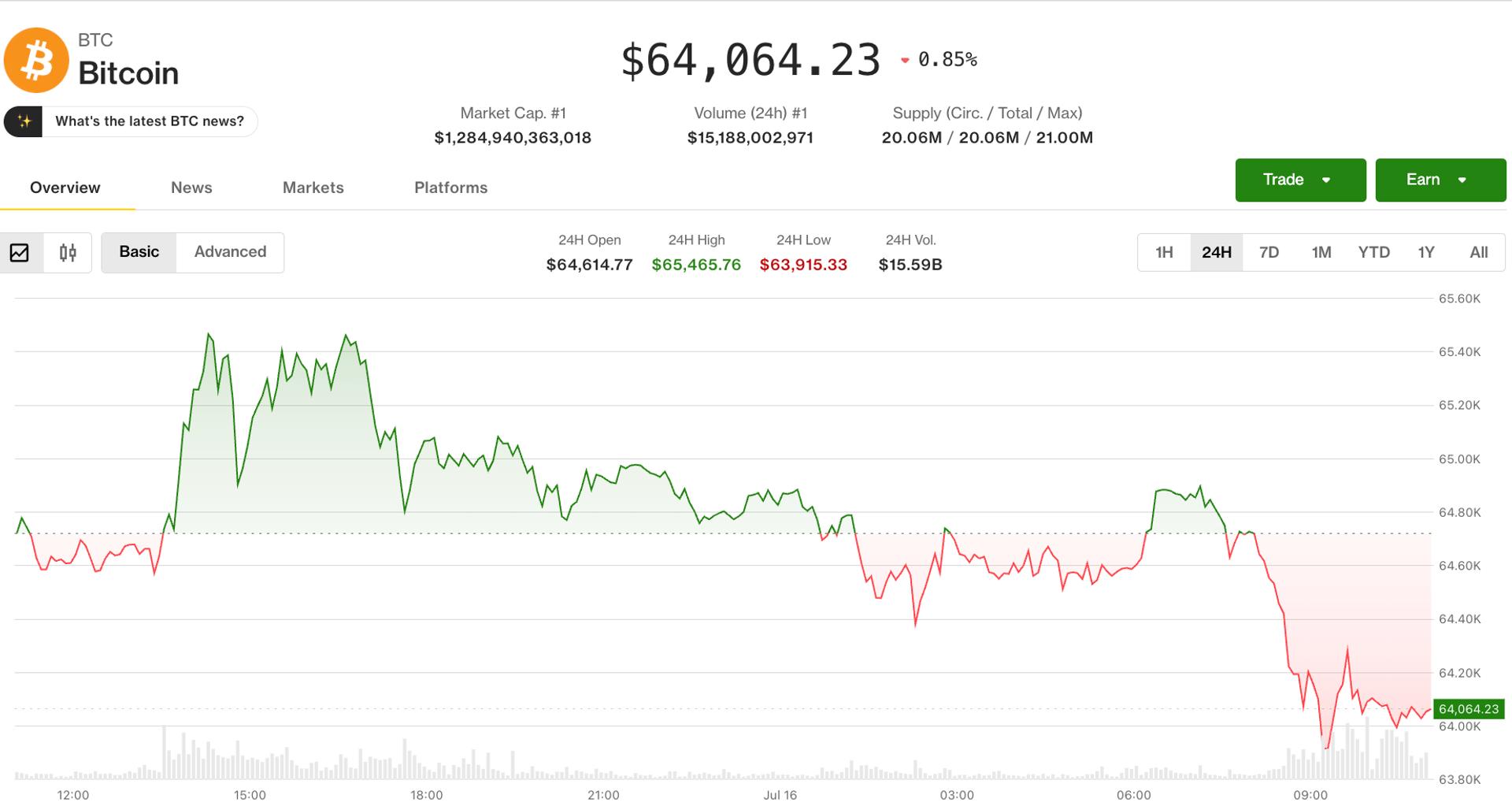
Bitcoin, the bellwether of the cryptocurrency market, recently experienced a significant pullback. After reaching a monthly high of approximately US$65,500, the digital asset retreated, finding itself trading closer to the US$64,000 mark. This downward movement wasn't an isolated incident; it triggered a broader bearish sentiment across many altcoins and the wider crypto ecosystem.
The primary catalysts for this market correction appear to be a combination of factors. A substantial portion of the selling pressure came from profit-taking. Investors who had seen their holdings appreciate after Bitcoin's recent rally opted to cash out, contributing to the downward trajectory. Simultaneously, geopolitical tensions, specifically the news of fresh Iranian strikes on US bases, injected a new layer of uncertainty into global financial markets, including cryptocurrencies.
Historically, Bitcoin and other digital assets have shown sensitivity to macroeconomic and geopolitical events. Increased global instability often leads investors to de-risk, moving capital out of more volatile assets. This flight to safety can temporarily outweigh positive market momentum, resulting in price corrections even after strong rallies. The quick shift from a monthly high to a significant dip underscores the market's current susceptibility to both internal profit-taking dynamics and external global events.
Why it matters for Australian investors
Australian investors, like their global counterparts, felt the ripple effect of Bitcoin's price adjustment. For those holding Bitcoin or other cryptocurrencies, the immediate impact was a decline in the Australian dollar (AUD) value of their portfolios. While Bitcoin's price is typically quoted in US dollars, its AUD equivalent fluctuates daily, directly influencing the local value of their digital assets.
Major Australian crypto exchanges such as CoinSpot, Independent Reserve, Swyftx, and BTC Markets would have observed increased trading activity, particularly selling, as local investors reacted to the downturn. These platforms provide the gateway for most Australians to enter and exit the crypto market, meaning price movements on the global stage directly translate to trading opportunities and portfolio revaluations for their users.
The volatility inherent in cryptocurrency markets, highlighted by this recent pullback, also carries implications for tax obligations. The Australian Taxation Office (ATO) considers cryptocurrencies as property for capital gains tax (CGT) purposes. Any profit-taking by Australian investors during this period, if it resulted in a capital gain, would be subject to CGT, requiring careful record-keeping throughout the financial year. Conversely, if the pullback led to realised losses, these could potentially be used to offset future capital gains, providing a small silver lining for some.
Impact on the AUD market
The Bitcoin pullback had a perceptible impact on the AUD-denominated cryptocurrency market. When Bitcoin's US dollar price falls, its value in Australian dollars follows suit, assuming a relatively stable AUD/USD exchange rate. This means an investor holding Bitcoin through an Australian exchange would see the AUD value of their investment decrease proportionally.
This kind of broad market movement can also influence Australian investor sentiment. A sharp decline after a peak may lead some newer investors to question the stability of their crypto holdings, while more experienced participants might view it as a buying opportunity. Australian retail and institutional investors often look for entry points during dips, potentially providing some support to the AUD crypto market as some 'buy the dip'.
Furthermore, the transparency and regulatory framework within Australia mean that such market movements are observed by financial oversight bodies like AUSTRAC, which monitors transactions for financial crime. While AUSTRAC's primary focus is on anti-money laundering and counter-terrorism financing, significant market volatility can sometimes correlate with shifts in trading patterns, which they would be observing as part of their broader remit. The overall health and stability of the global crypto market, therefore, has indirect implications for the regulatory environment locally.
What to watch next
The cryptocurrency market remains highly dynamic, and several factors could influence Bitcoin's next move. Investors should closely monitor global geopolitical developments. Any de-escalation of tensions could foster a risk-on environment, potentially supporting crypto prices. Conversely, further instability may lead to continued caution and downward pressure.
On the technical analysis front, observing key support and resistance levels for Bitcoin will be crucial. A sustained break above the US$65,500 monthly high could signal renewed bullish momentum, while a further dip below critical support could indicate a deeper correction. Australian investors should also pay attention to the AUD/USD exchange rate, as a strengthening Australian dollar could partially offset US dollar denominated price dips, and vice versa.
Beyond Bitcoin, the performance of major altcoins will offer insights into market breadth. If altcoins continue to underperform significantly even as Bitcoin attempts a recovery, it might suggest a cautious market with capital concentrating towards the perceived safety of Bitcoin. Conversely, a broad-based rally across the altcoin market could signal a healthier, more confident ecosystem. Regulatory news, particularly from major jurisdictions, can also impact market sentiment, as can upcoming halving events or major protocol upgrades.
Coins covered

Common questions
How does Bitcoin's price in US dollars affect its value on Australian exchanges?
Bitcoin's price on Australian exchanges like CoinSpot or Swyftx is directly derived from its global US dollar price, converted into Australian dollars using the prevailing AUD/USD exchange rate. So, if Bitcoin's US dollar price drops, its AUD value will also fall, assuming the exchange rate remains relatively stable.
Do Australian investors pay tax on profit-taking from crypto during market pullbacks?
Yes, the Australian Taxation Office (ATO) treats cryptocurrencies as property for capital gains tax (CGT) purposes. If an Australian investor sells their crypto for a profit, even if they were profit-taking during a market pullback, any realised capital gain is subject to CGT. It's crucial to keep accurate records of all transactions for tax purposes.
What role do Australian regulators play during cryptocurrency market volatility?
Australian regulators like AUSTRAC monitor transactions for financial crime, including during periods of market volatility. While ASIC's focus is on consumer protection and market integrity for financial products, they also monitor the broader crypto environment. Their role generally involves ensuring compliance with existing laws and assessing risks, rather than directly controlling crypto prices.
Bitcoin's recent pullback to US$64,000 sparked profit-taking and geopolitical concerns. Learn what it means for Australian investors and the AUD market.
About this article: this is an AI-generated summary of reporting by CoinDesk. It has not been reviewed by a human editor. We use AI to localise crypto news for Australian readers, and we link back to the original source so you can verify the facts.
Informational only — not financial advice. Always do your own research. Read our AI & editorial policy →