
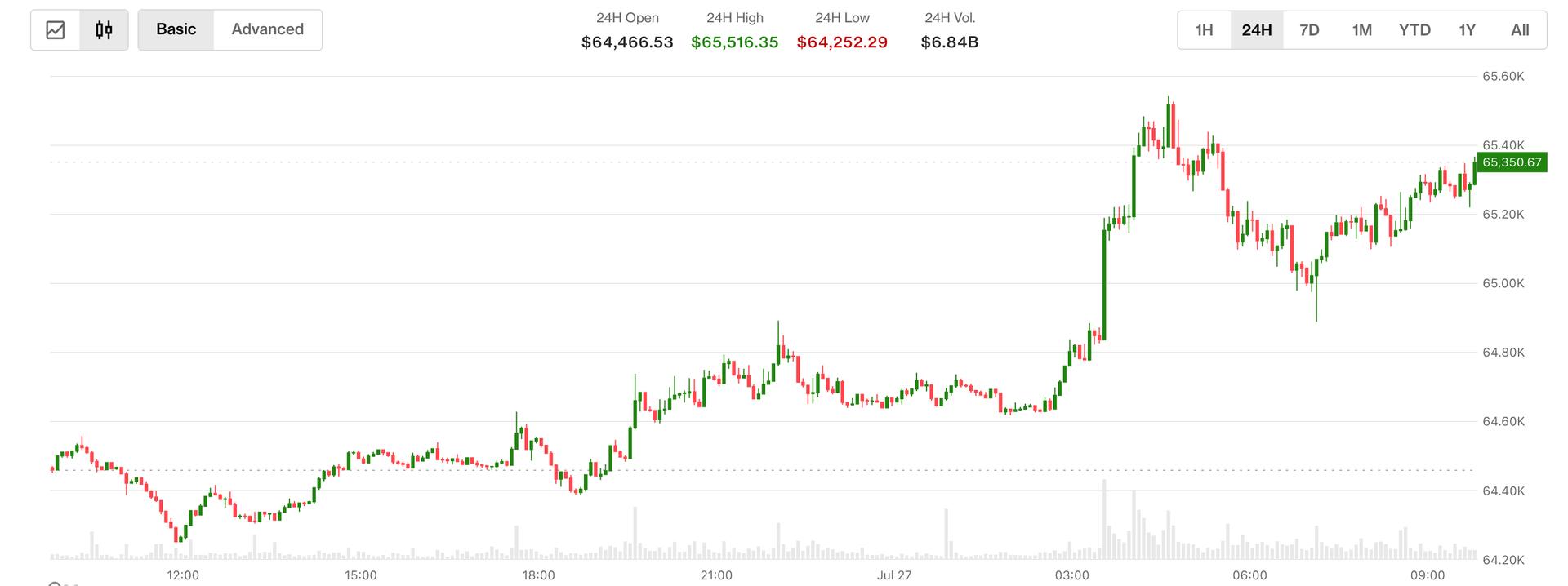
Bitcoin is back above $65,000 as U.S. and Iran hold fire. Oil drops 5%
AI-summarised from reporting by CoinDesk. How we use AI.
What happened
Bitcoin has once again clawed its way back above the US$65,000 threshold, a notable recovery following recent market jitters. This upward movement appears to be largely influenced by de-escalation in geopolitical tensions. Specifically, the United States and Iran have indicated a pause in their recent hostilities, which had previously cast a shadow over global financial markets.
The broader market relief extended beyond just cryptocurrencies. Traditional assets like oil also reacted positively, with a significant 5% drop in prices. This cooling of a key commodity often indicates a reduction in perceived supply risks, leading to improved investor sentiment across various asset classes.
Adding another layer to this market dynamic, Ethereum (ETH) has demonstrated a particularly strong performance. Against Bitcoin (BTC), ETH has shown outperformance, a metric closely watched by crypto investors. This relative strength in Ethereum is often interpreted by analysts as a potential precursor to a wider altcoin market rally, where other digital assets could see increased interest and price appreciation.
Why it matters for Australian investors
For Australian investors, Bitcoin's return above US$65,000 and the broader market stability are welcome developments. While the direct geopolitical events are offshore, their influence on global risk appetite has a ripple effect on Australian dollar (AUD) denominated crypto prices. A more stable global outlook generally fosters greater confidence in risk assets, including digital currencies.
The outperformance of Ethereum warrants particular attention. Australian crypto investors often hold diversified portfolios, and ETH's strength can signal a shift in market momentum. Should an altcoin rally materialise, it could present opportunities across various digital assets available on Australian exchanges like CoinSpot, Independent Reserve, Swyftx, and BTC Markets.
Furthermore, the influence of global oil prices on the broader economy is significant. A drop in oil can alleviate inflationary pressures, which could impact interest rate expectations. For Australian investors, this can indirectly affect the capital available for crypto investments and the general economic outlook, which often correlates with a willingness to invest in higher-risk assets.
Impact on the AUD market
When Bitcoin crosses significant psychological thresholds in USD, its value in Australian dollars also sees a corresponding movement, adjusted for the prevailing AUD/USD exchange rate. Australian investors buying or selling on local platforms will experience these fluctuations directly. A recovering Bitcoin price in USD terms, coupled with a stable or strengthening AUD, enhances returns for local holders.
Local exchanges and investment platforms track these global movements closely. While the primary drivers are international, the pricing mechanisms on Australian platforms like those regulated by AUSTRAC, will reflect these changes instantaneously. The health of the global crypto market strongly dictates the sentiment and trading volumes within the Australian market.
For tax purposes, the Australian Taxation Office (ATO) treats cryptocurrencies as property. Any capital gains or losses from selling digital assets, including those experiencing a post-geopolitcal rally, are subject to tax. Australian investors need to remain cognisant of their tax obligations, regardless of market movements, and ensure accurate record-keeping of their trades on local and international platforms.
What to watch next
The key takeaway for Australian investors is the continued monitoring of both geopolitical events and broader economic indicators. While the immediate tensions have eased, the global landscape remains dynamic. Any resurgence in global uncertainty could quickly reverse positive market sentiment, impacting crypto prices once again.
Domestically, keep an eye on how Australian regulators like ASIC respond to evolving global crypto trends. While direct intervention related to an international market rally is unlikely, their ongoing focus on investor protection and market integrity influences the local operating environment for crypto businesses and investors.
From a market perspective, the sustainability of Ethereum's outperformance is crucial. If ETH continues to lead, it could indeed usher in the much-anticipated altcoin season. This would mean looking beyond just Bitcoin dominance and exploring opportunities across a wider range of digital assets listed on Australian exchanges, always remembering to conduct thorough due diligence and manage risk appropriately.
Ultimately, stability in traditional markets often translates to greater confidence in the crypto space. Australian investors should continue to diversify, stay informed about global economic shifts, and understand the regulatory landscape within Australia to navigate the evolving digital asset market effectively.
Coins covered



Common questions
How does geopolitical tension affect Bitcoin's price in Australia?
Geopolitical tensions often lead to increased global uncertainty, which can cause investors to move away from 'risk-on' assets like Bitcoin. This global trend directly influences Bitcoin's price in USD, which then translates to its price on Australian exchanges. A de-escalation, as seen recently, typically has the opposite effect, boosting confidence.
What does ETH outperforming BTC mean for my Australian crypto portfolio?
When Ethereum (ETH) outperforms Bitcoin (BTC), it suggests a potential shift where investors are looking beyond just Bitcoin, often signalling a broader interest in altcoins. For an Australian portfolio, this could mean an opportunity for diversified holdings to see gains, but it's important to research individual altcoins and manage risk.
Do I pay tax on crypto gains if the market recovers in Australia?
Yes, in Australia, the Australian Taxation Office (ATO) treats cryptocurrency as property for tax purposes. If you make a capital gain from selling, trading, or otherwise disposing of cryptocurrency, it is generally subject to Capital Gains Tax (CGT). This applies regardless of whether the market is recovering or falling.
Bitcoin soars past US$65,000 as global tensions ease. Unpack what this means for Australian crypto investors and the AUD market.
About this article: this is an AI-generated summary of reporting by CoinDesk. It has not been reviewed by a human editor. We use AI to localise crypto news for Australian readers, and we link back to the original source so you can verify the facts.
Informational only — not financial advice. Always do your own research. Read our AI & editorial policy →