
Bitcoin clings to $75,000 support as bear market signals resurface
AI-summarised from reporting by CoinDesk. How we use AI.
What happened
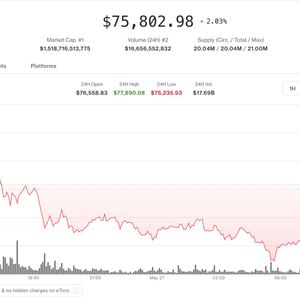
Bitcoin has recently demonstrated a notable struggle to maintain price levels above the key psychological and technical threshold of $75,000. This struggle comes amidst a broader market sentiment hinting at the resurgence of bearish signals. While the majority of the cryptocurrency market has experienced a downturn, some altcoins, including Hyperliquid and Monero, have surprisingly shown resilience and even growth.
This divergence indicates a complex market environment where Bitcoin's dominance might be facing challenges as investors seek refuge or alternative opportunities in specific niches. The inability of Bitcoin to firmly establish a position above this critical level is being closely watched by analysts and investors globally, including those in the Australian market. It suggests a period of caution and potential re-evaluation of strategies.
Several factors could be contributing to this wavering, ranging from macroeconomic uncertainties to shifting institutional interest. The prevailing market narratives around inflation, interest rate hikes, and geopolitical tensions undoubtedly play a role in dampening investor enthusiasm for risk assets like cryptocurrencies. This sentiment often puts downward pressure on Bitcoin, which remains a bellwether for the broader crypto ecosystem.
The resilience of certain altcoins, however, suggests a nuanced market. While Bitcoin navigates choppy waters, project-specific developments, or unique value propositions for coins like Hyperliquid and Monero, might be insulating them from the broader market's malaise. This phenomenon highlights the increasingly heterogeneous nature of the crypto market, where not all assets move in lockstep with Bitcoin.
Why it matters for Australian investors
For Australian investors, Bitcoin's current price action and the associated bear market signals carry significant implications. The Australian dollar (AUD) price for Bitcoin directly correlates with its USD value, meaning any downturn is immediately reflected in local portfolios. Investors using Australian exchanges like CoinSpot, Independent Reserve, Swyftx, and BTC Markets will be keenly observing these trends.
Understanding these market shifts is crucial for managing investment strategies, especially given Australia's robust regulatory environment. The Australian Taxation Office (ATO) views cryptocurrencies as property for capital gains tax purposes, meaning any disposals — including sales or trades — can trigger tax events. A volatile market with downward pressure often leads to increased trading activity, which Australian investors need to carefully track for tax reporting.
Furthermore, market stability or instability can influence the sentiment towards cryptocurrency adoption and regulation within Australia. While organisations like AUSTRAC oversee anti-money laundering and counter-terrorism financing in the crypto space, significant market shifts can prompt further discussion from regulators like ASIC regarding investor protection and market integrity. This vigilance is paramount for maintaining a healthy and secure Australian digital asset ecosystem.
The performance of key cryptocurrencies also affects the perceived legitimacy and potential for wider uptake of digital assets in Australia. A sustained period of bearish signals for Bitcoin could temper enthusiasm from new institutional investors or traditional financial services considering deeper dives into the crypto market. Conversely, strong performance from altcoins in a Bitcoin downturn could highlight diversification opportunities.
Impact on the AUD market
The AUD market for cryptocurrencies is not isolated from global trends. When Bitcoin struggles to hold key support levels, Australian investors often react similarly to their international counterparts. This can manifest as increased selling pressure on Australian exchanges, or a shift in capital towards more stable assets, including traditional safe havens or even other, more resilient cryptocurrencies.
Pricing of Bitcoin against the AUD naturally fluctuates in tandem with the USD price and the AUD/USD exchange rate. A weakening Bitcoin price combined with a strong AUD could exacerbate losses for Australian investors. Conversely, a weaker AUD could partially offset some of these declines, though the primary driver remains Bitcoin's inherent market value.
Moreover, the health of the broader cryptocurrency market can influence the development of new financial products and services within Australia. If the market experiences a prolonged downturn, the incentive for Australian fintech companies to launch new crypto-related offerings, such as exchange-traded funds (ETFs) or innovative payment solutions, might diminish. This could slow the pace of crypto integration into Australia's financial landscape.
Investor confidence, a critical component of any market, can also be impacted. A sustained period of bearish signals may lead some Australian investors to liquidate positions or reduce their exposure to digital assets, opting for more traditional investment vehicles. This capital rotation can have a ripple effect, reducing liquidity within the AUD crypto market and potentially making price movements more pronounced.
What to watch next
Australian investors should closely monitor Bitcoin's ability to reclaim and sustain above the $75,000 threshold. A decisive break above this level, coupled with increased trading volume, could signal a potential reversal of the bearish sentiment. Conversely, a continued struggle or a fall below further support levels could indicate a more prolonged downturn.
Keep an eye on macroeconomic indicators, particularly global inflation rates and central bank interest rate decisions. These factors significantly influence risk appetite and can either fuel or dampen interest in cryptocurrencies. Developments in the traditional finance sector regarding crypto adoption, or shifts in regulatory stances from organisations like ASIC, will also be pivotal.
The performance of altcoins, especially those demonstrating resilience like Hyperliquid and Monero, merits attention. Their ability to buck the trend could highlight emerging narratives or sector rotations within the crypto market. Observing whether this resilience persists or if these altcoins eventually succumb to broader market pressures will provide further insights into market dynamics.
Finally, significant on-chain data metrics, such as exchange inflows and outflows, large whale movements, and network activity, can offer early indications of sentiment shifts. For Australian investors, staying informed through reputable sources and understanding how global events translate to the AUD market is crucial for navigating these complex times effectively.
Coins covered



Common questions
How does Bitcoin's price impact my ATO tax obligations in Australia?
In Australia, the ATO treats Bitcoin as property for capital gains tax purposes. This means that if the value of your Bitcoin changes and you dispose of it (e.g., sell it for AUD, trade it for another crypto, or use it to purchase goods), you may incur a capital gains or loss. A fluctuating Bitcoin price means you'll need to accurately track the cost base and disposal price for each transaction to calculate your tax liability correctly.
Are Australian exchanges like CoinSpot and Swyftx affected differently by Bitcoin's performance downturn?
Australian exchanges such as CoinSpot, Independent Reserve, Swyftx, and BTC Markets primarily facilitate the buying and selling of cryptocurrencies for AUD. While they are resilient platforms, a Bitcoin performance downturn will generally lead to reduced trading volume or increased selling activity on these platforms, mirroring global trends. Their operations focus on providing a secure and regulated marketplace, overseen by AUSTRAC, regardless of market conditions, but user activity directly reflects price action.
What should Australian investors consider regarding altcoins like Monero during a Bitcoin downturn?
During a Bitcoin downturn, altcoins can exhibit varied performance. Some might follow Bitcoin's lead, while others, like Monero (XMR), might show resilience due to specific use cases, privacy features, or independent development. Australian investors considering altcoins during such periods should conduct thorough research into their fundamentals, market cap, liquidity, and long-term viability, and remember that altcoin investments carry their own unique risk profile compared to Bitcoin.
Bitcoin struggles below $75,000, resurfacing bear market signals. Discover what this means for Australian investors, ATO tax, and exchanges like CoinSpot.
About this article: this is an AI-generated summary of reporting by CoinDesk. It has not been reviewed by a human editor. We use AI to localise crypto news for Australian readers, and we link back to the original source so you can verify the facts.
Informational only — not financial advice. Always do your own research. Read our AI & editorial policy →