
Bitcoin bounces from $58,000 as derivatives signal more pain in the pipeline
AI-summarised from reporting by CoinDesk. How we use AI.
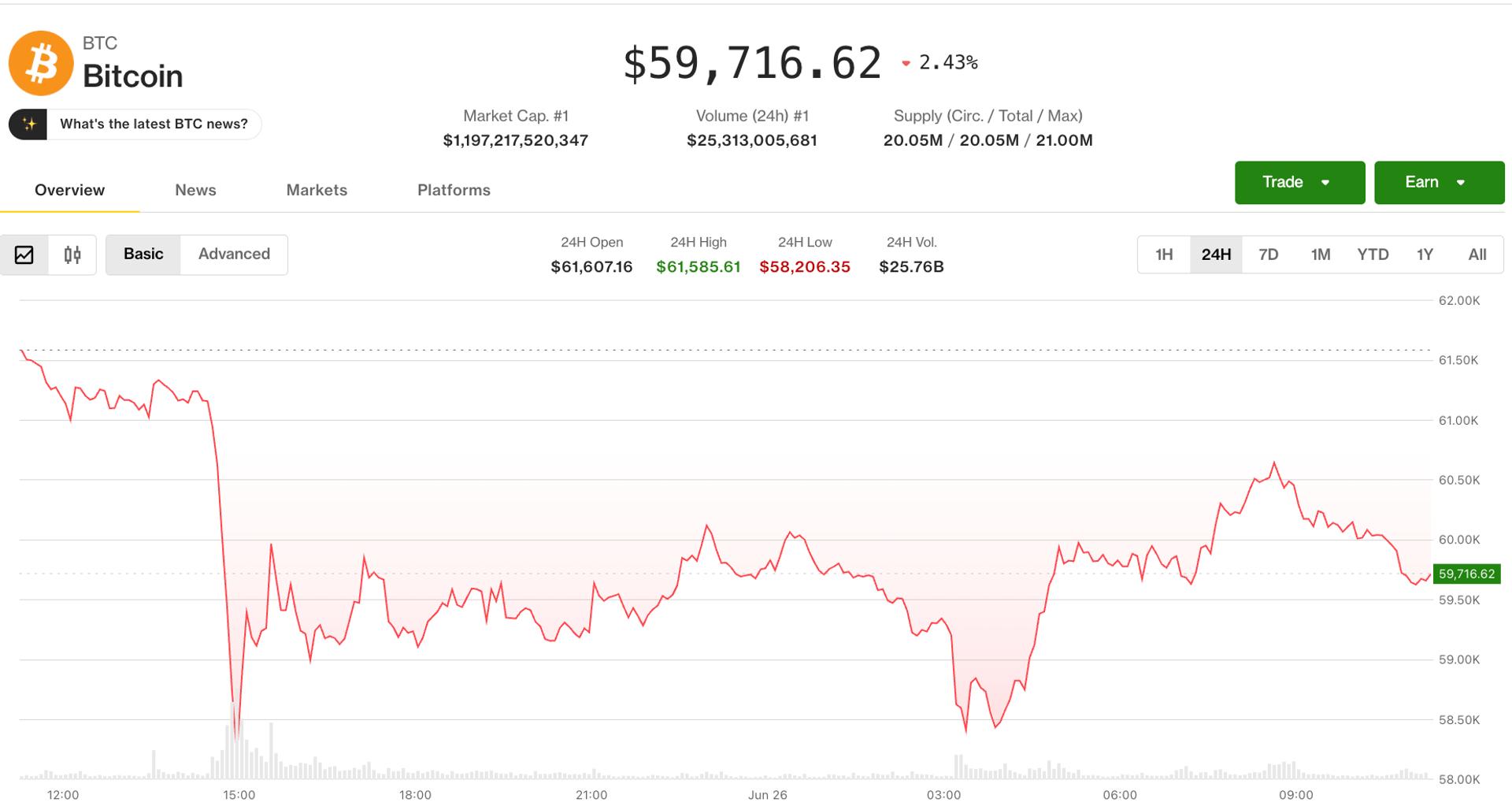
What happened
Bitcoin, the leading cryptocurrency by market capitalisation, recently experienced a significant price fluctuation, touching its lowest point since September 2024 before staging a modest rebound. This downturn for Bitcoin was accompanied by further price slippage for Ethereum, another major digital asset. The broader cryptocurrency market witnessed substantial derivatives liquidations, with a staggering $1 billion in futures positions being wiped out during this volatile period.
These market movements underscore the inherent volatility within the crypto space. Large-scale liquidations often occur when significant price movements trigger margin calls, forcing the automatic closure of leveraged trading positions. This can create a domino effect, accelerating price declines as more positions are force-closed.
Such events are not uncommon in the cryptocurrency market, known for its rapid price swings and susceptibility to both technical and sentiment-driven factors. The interplay between spot prices and the derivatives market, particularly futures, often amplifies these movements, leading to dramatic shifts in market value.
Why it matters for Australian investors
For Australian investors, these market dynamics highlight the importance of prudent risk management and staying informed about global crypto trends. While many investors might focus on a cryptocurrency's AUD price, underlying global factors, such as derivatives market activity, frequently dictate these local movements. A significant dip in Bitcoin's USD value, for instance, will almost invariably be reflected in its AUD trading pairs across platforms like CoinSpot, Independent Reserve, Swyftx, and BTC Markets.
The recent swings reinforce the Australian Tax Office's (ATO) stance on cryptocurrency assets, which are generally treated as property for capital gains tax purposes. Significant price movements, whether up or down, can trigger tax events for investors who buy, sell, trade, or dispose of their digital assets. Investors should maintain meticulous records of their transactions to comply with ATO requirements.
Furthermore, the volatility underscores the need for Australian investors to understand the regulatory landscape. Organisations like AUSTRAC play a crucial role in preventing financial crime within the digital asset space, while ASIC provides guidance on investment products that reference cryptocurrencies. Adhering to best practices, including using reputable Australian exchanges that comply with local regulations, is paramount for security and compliance.
Impact on the AUD market
The immediate impact on the AUD cryptocurrency market was a reflection of the global price reduction. As Bitcoin and Ethereum prices fell in USD terms, their corresponding AUD values on Australian exchanges also declined. This is a direct consequence of the interconnectedness of the global crypto market, where arbitrage opportunities quickly align prices across different fiat currencies.
Australian investors holding or looking to acquire these assets would have seen their portfolios or potential entry points adjust in line with the international market. The AUD's own strength or weakness against the USD can also subtly influence the final AUD price; however, the primary driver during such global market events is typically the underlying asset's USD valuation.
The volume of trading on Australian platforms like CoinSpot and Swyftx might have increased during this period of heightened volatility, as some investors might 'buy the dip' while others may have sought to reduce their exposure. However, the overarching trend in AUD prices would have mirrored the global downturn, reflecting the strong correlation between local and international crypto markets.
What to watch next
Moving forward, Australian investors should closely monitor global macroeconomic indicators, as these often influence broader market sentiment, including that for cryptocurrencies. Key economic data releases, central bank decisions, and geopolitical events can all have flow-on effects for digital asset prices globally, and by extension, for AUD-denominated crypto assets.
Another critical area to observe is the continued activity within the derivatives market. Elevated futures open interest and funding rates can sometimes signal potential for future volatility or price corrections. Understanding these indicators, even if not directly participating in derivatives trading, can provide insights into potential market shifts.
Finally, keeping an eye on regulatory developments both domestically and internationally will be crucial. Changes to Australia's regulatory framework by ASIC or AUSTRAC, or significant policy shifts in major global markets, could impact the operational environment for exchanges and the perceived safety of digital assets, influencing investor behaviour. Diversification and a clear understanding of personal risk tolerance remain essential strategies for navigating this dynamic market.
Coins covered


Common questions
How does the ATO view cryptocurrency for tax purposes in Australia?
The Australian Tax Office (ATO) generally treats cryptocurrency as property for capital gains tax (CGT) purposes. This means that if you sell, trade, or otherwise dispose of your cryptocurrency, you may be liable for CGT on any gains you make. Records of all transactions, including purchase and disposal dates and prices, are crucial for accurate tax reporting.
Which Australian crypto exchanges are regulated?
In Australia, cryptocurrency exchanges that offer fiat-to-crypto trading services are regulated by AUSTRAC for anti-money laundering and counter-terrorism financing (AML/CTF) purposes. Reputable Australian platforms like CoinSpot, Independent Reserve, Swyftx, and BTC Markets comply with these AUSTRAC requirements to operate legally and securely within the country.
Does the fall in Bitcoin's USD price directly affect its AUD price on Australian exchanges?
Yes, absolutely. The global cryptocurrency market is highly interconnected. When Bitcoin's price fluctuates in USD terms, its AUD price on Australian exchanges almost immediately reflects these changes. Exchange rates between AUD and USD also play a minor role, but the primary driver of AUD price movements for Bitcoin and other major cryptocurrencies is their global USD valuation.
Bitcoin's recent drop to its lowest since September 2024 and rebound, along with $1B in liquidations, analysed for Australian crypto investors.
About this article: this is an AI-generated summary of reporting by CoinDesk. It has not been reviewed by a human editor. We use AI to localise crypto news for Australian readers, and we link back to the original source so you can verify the facts.
Informational only — not financial advice. Always do your own research. Read our AI & editorial policy →