
Altcoin Season Index at 49 — Traders Need Bitcoin Dominance Below 55% to Trigger Rotation
AI-summarised from reporting by Bitcoin.com. How we use AI.
What happened
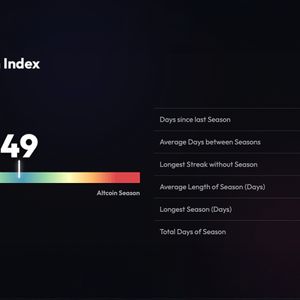
Bitcoin's recent price correction, seeing it dip below the US$70,000 mark, has had a ripple effect across the broader cryptocurrency market. This downturn saw Bitcoin's market dominance, a metric indicating its share of the total crypto market capitalisation, recede to approximately 58%. Concurrently, the Altcoin Season Index, a measure used to gauge the prevalence of altcoin outperformance compared to Bitcoin, shifted to a reading of 49.
Typically, an Altcoin Season Index above 75 signals a period where 75% of the top 50 altcoins have outperformed Bitcoin over the last 90 days. Conversely, an index below 25 often indicates a 'Bitcoin Season'. The current reading of 49 suggests a neutral to slightly favouring Bitcoin environment, rather than a full-blown altcoin season. This movement has sparked discussion among traders globally about potential capital rotation from Bitcoin into altcoins, though current data doesn't definitively confirm such a significant shift.
The decline in Bitcoin's dominance is often eyed by market participants as a precursor to altcoin rallies. When Bitcoin's price softens and its market share decreases, it can signal that investors are diversifying their holdings into alternative cryptocurrencies, anticipating higher growth potential in these assets. However, a sustainable altcoin season typically requires Bitcoin's dominance to fall to more significant thresholds, often cited below 55%.
Why it matters for Australian investors
For Australian investors, these market dynamics are particularly relevant. Movements in Bitcoin's dominance and the Altcoin Season Index can influence portfolio strategies, especially concerning the allocation between Bitcoin and various altcoins. A sustained altcoin season could present opportunities for higher returns for those holding diversified portfolios, or those looking to expand beyond Bitcoin and Ethereum.
Australian crypto exchanges, such as CoinSpot, Independent Reserve, Swyftx, and BTC Markets, offer a wide array of altcoins, making these potential investment opportunities accessible. However, it's crucial for Australian investors to remember that altcoins generally carry higher volatility and risk compared to Bitcoin. Market downturns tend to impact altcoins more severely, highlighting the importance of thorough due diligence and risk management.
Regulatory considerations for Australian investors also remain paramount. The Australian Taxation Office (ATO) treats cryptocurrency as property, meaning capital gains tax applies to profits made from selling, swapping, or even using crypto for purchases. Understanding these tax implications is essential regardless of whether an investor is profiting from Bitcoin or altcoins. Staying informed about AUSTRAC's anti-money laundering (AML) and counter-terrorism financing (CTF) regulations, which govern Australian cryptocurrency service providers, is also prudent, as these frameworks ensure a secure and compliant trading environment.
Impact on the AUD market
The interplay between Bitcoin's dominance and altcoin performance can have a notable impact on the Australian dollar (AUD) cryptocurrency market. When altcoins experience significant price movements, trading volumes on Australian exchanges often increase, as local investors participate in these trends. This can lead to greater liquidity within AUD-denominated crypto pairs, potentially offering better execution prices for traders.
However, the overall sentiment in the global crypto market, heavily influenced by Bitcoin's performance, continues to dictate the broader direction for AUD-paired cryptocurrencies. A bullish altcoin season could see the AUD value of various altcoins surge, attracting new capital and potentially broader adoption within Australia. Conversely, a prolonged 'Bitcoin Season' where altcoins underperform could see capital consolidate back into Bitcoin or even out of the crypto market altogether, affecting AUD-denominated trading volumes and liquidity.
Australian investors often use stablecoins pegged to the AUD or USD when navigating volatility or looking to re-enter the market. During periods of uncertainty or a shift in market dominance, the strategic use of these stablecoins, available on local platforms, becomes even more critical for capital preservation and tactical re-entry. ASIC's ongoing focus on investor protection also means that exchanges are under scrutiny to provide clear information, which helps Australian investors make informed decisions during periods of market fluctuation.
What to watch next
The key metric to monitor moving forward is Bitcoin's dominance. Many analysts suggest that a sustained altcoin season typically requires Bitcoin dominance to fall below the 55% threshold, and some even point to 50% or lower as a more definitive indicator. If Bitcoin's dominance continues its current trajectory downwards and breaches these significant levels, it could signal a more robust and widespread altcoin rally.
Investors should also keep an eye on capital flows. Are new funds entering the broader crypto market, or is capital simply rotating from Bitcoin into altcoins and vice versa? Net positive inflows into the altcoin market, rather than just internal rotation, would be a stronger indicator of a genuine altcoin season. This often correlates with growing interest from institutional investors and broader market adoption, which would benefit the entire ecosystem, including the Australian crypto market.
Furthermore, the performance of major altcoins, particularly Ethereum, will be crucial. Ethereum often acts as a bellwether for the altcoin market due to its large market capitalisation and extensive ecosystem. Should Ethereum show strong momentum against Bitcoin, it could pull other altcoins higher. Australian investors should also consider global macroeconomic factors and regulatory developments, both locally and internationally, as these can significantly influence market sentiment and capital allocation in the dynamic world of digital assets.
Coins covered



Common questions
What does 'Altcoin Season Index at 49' mean for my crypto investments in Australia?
An Altcoin Season Index at 49 indicates a neutral to slightly Bitcoin-favouring market rather than a full altcoin season. For Australian investors, this means altcoins are generally not yet outperforming Bitcoin significantly over the last 90 days. It suggests caution, as a strong altcoin rally isn't confirmed yet, and Bitcoin might still be the primary driver of market sentiment.
How does Bitcoin dominance affect the altcoin market available on Australian exchanges?
Bitcoin dominance measures BTC's share of the total crypto market. When it's high, Bitcoin tends to lead the market, and altcoins may struggle. When it falls, especially below 55%, it often signals a shift where capital flows into altcoins, potentially boosting their prices across Australian exchanges like CoinSpot and Swyftx. This creates opportunities for Australian investors looking beyond Bitcoin.
Are there any specific ATO tax implications for Australian investors during an 'altcoin season'?
Yes, regardless of market conditions, the ATO considers cryptocurrencies as property. During an altcoin season, if you sell altcoins for a profit, swap them for other altcoins or Bitcoin, or use them to purchase goods/services, you will incur a capital gains tax (CGT event). It's crucial for Australian investors to keep detailed records of all transactions to accurately report their tax obligations.
Bitcoin's dominance dips, pushing the Altcoin Season Index to 49. Explore what this market shift means for Australian crypto investors and the AUD market.
About this article: this is an AI-generated summary of reporting by Bitcoin.com. It has not been reviewed by a human editor. We use AI to localise crypto news for Australian readers, and we link back to the original source so you can verify the facts.
Informational only — not financial advice. Always do your own research. Read our AI & editorial policy →