
AI frenzy losing steam leaves bitcoin less volatile than South Korean stocks
AI-summarised from reporting by CoinDesk. How we use AI.
What happened
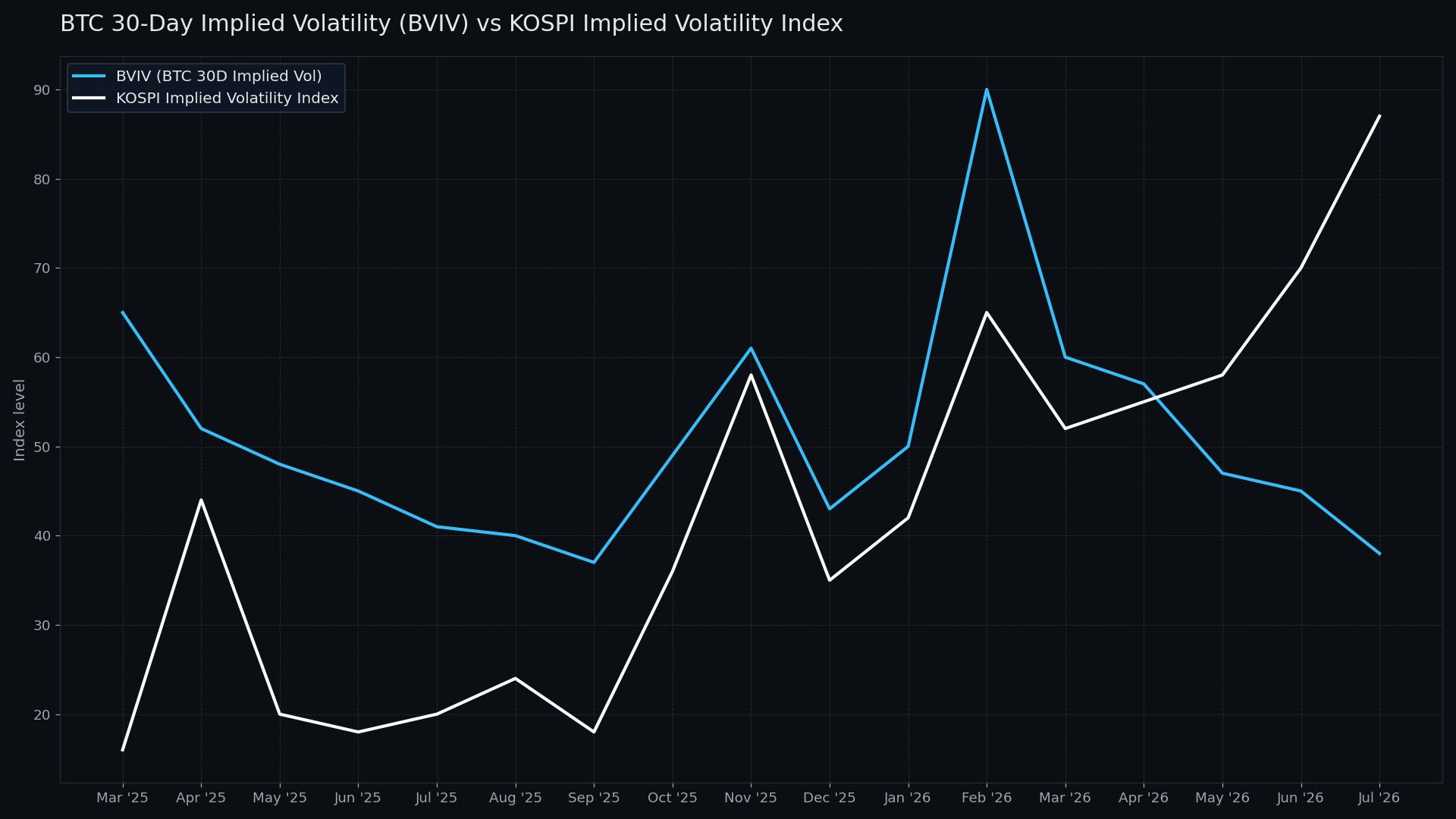
Bitcoin, often characterised by its pronounced price swings, has recently demonstrated a surprising period of relative stability. This comes at a time when the broader financial markets are experiencing a pullback in the exuberance surrounding artificial intelligence (AI) related stocks. The traditional narrative associates Bitcoin with heightened volatility, often exceeding that of conventional assets.
However, a notable shift has occurred. Bitcoin's volatility has dipped below that of the South Korean stock market, which is particularly sensitive to fluctuations in the technology sector and, by extension, AI developments. This points to a potential maturing of the cryptocurrency, or at least a temporary rebalancing of investor sentiment across different asset classes. The comparison highlights a fascinating decoupling from typical market perceptions.
The AI sector has seen a cooling off, leading to a decrease in the rapid ascent of tech stocks. This has, in turn, introduced greater volatility into equity markets that were previously riding high on the AI wave. Bitcoin, on the other hand, appears to be charting its own course, showing resilience amidst these shifts. This trend could signal a change in how various asset classes are perceived in terms of risk.
Why it matters for Australian investors
For Australian investors, this development offers a fresh perspective on Bitcoin as an asset. Historically, the 'speculative' label attached to cryptocurrencies often deterred more conservative portfolios. If Bitcoin's volatility can sustainably settle below that of certain national equity markets, it might encourage a re-evaluation of its role within a diversified Australian investment strategy.
Australian crypto exchanges like CoinSpot, Independent Reserve, Swyftx, and BTC Markets facilitate access to Bitcoin for local investors. The reduced volatility could make it a more appealing option for those looking to allocate a portion of their portfolio to digital assets without being exposed to extreme short-term price swings. This is particularly relevant given the Australian Taxation Office's (ATO) clear guidance on how cryptocurrency is treated for tax purposes, meaning any gains or losses are certainly on their radar.
Furthermore, the Australian Securities and Investments Commission (ASIC) continues to monitor the cryptocurrency landscape to protect consumers. A more stable Bitcoin market could align better with regulatory expectations for mature financial products, potentially paving the way for clearer regulatory frameworks in the future. Reduced volatility might also impact how superannuation funds, which are increasingly exploring digital asset exposure, might view Bitcoin as a viable investment.
Impact on the AUD market
The relative stability of Bitcoin could have subtle but significant implications for the Australian dollar (AUD) market. While Bitcoin is not directly pegged to the AUD, shifts in demand for a global asset like Bitcoin can influence broader sentiment. If global investors perceive Bitcoin as a less volatile store of value compared to certain equity markets, it could potentially draw capital that might otherwise flow into traditional assets, including AUD-denominated investments.
Australian investors holding Bitcoin priced in AUD on local exchanges would experience fewer extreme value fluctuations. This could lead to a more predictable investment environment, reducing the stress associated with rapid gains or losses. The reduced volatility might also influence the sophistication of financial products offered by Australian institutions, should Bitcoin become a more mainstream and stable asset.
However, it's also important to consider that a lack of volatility can sometimes be interpreted as a lack of excitement or growth potential by some investors. The interplay between global market sentiment and local AUD pricing remains complex. AUSTRAC, Australia's financial intelligence agency, plays a critical role in monitoring transactions to guard against financial crime, and an evolving crypto market profile might lead to ongoing adjustments in their risk assessments.
What to watch next
Investors should closely monitor whether this trend of lower Bitcoin volatility is a temporary anomaly or the beginning of a more sustained pattern. Key indicators will include global macroeconomic conditions, particularly the future trajectory of interest rates and inflation, which heavily influence traditional asset markets and, by extension, investor appetite for risk assets like Bitcoin.
Another crucial area to observe is the continued development and adoption of AI technologies. If the AI sector experiences a renewed surge, will Bitcoin maintain its independent volatility profile, or will it once again become correlated with tech-driven market movements? The decoupling suggests a growing maturity, but market dynamics are ever-shifting.
Furthermore, regulatory developments in major jurisdictions, including Australia, will remain paramount. The ongoing discussions concerning stablecoin regulation, exchange licensing, and broader digital asset frameworks could all influence Bitcoin's market perception and stability. Australian investors should pay attention to updates from ASIC and the ATO as these will directly impact their interactions with crypto assets.
Coins covered

Common questions
How does Bitcoin's volatility compare to traditional Australian stocks?
Historically, Bitcoin has been significantly more volatile than most traditional Australian stocks. However, recent trends have shown Bitcoin's volatility dipping below that of some international equity markets. While a direct comparison to the entire ASX might not be like-for-like, this indicates a potential shift towards greater stability for Bitcoin, a factor Australian investors may wish to consider.
Are there tax implications for Australian investors if Bitcoin becomes less volatile?
Yes, the tax implications for Australian investors remain the same regardless of Bitcoin's volatility. The ATO classifies cryptocurrency as property, and capital gains tax applies when you sell, swap, or otherwise dispose of it. Reduced volatility might mean fewer significant capital gains or losses in short periods, but reporting your crypto activities to the ATO is still mandatory.
Can Australian superannuation funds invest in Bitcoin if its volatility decreases?
Australian superannuation funds, particularly self-managed super funds (SMSFs), can and do invest in Bitcoin, provided their trust deed and investment strategy allow for it. A sustained decrease in Bitcoin's volatility could make it a more appealing and less risky asset for SMSFs and potentially even larger institutional super funds to consider as part of a diversified portfolio, aligning better with their long-term investment objectives.
Bitcoin volatility dips below South Korean stocks amidst AI tech pullback. CoinPulse AU analyses what this means for Australian crypto investors.
About this article: this is an AI-generated summary of reporting by CoinDesk. It has not been reviewed by a human editor. We use AI to localise crypto news for Australian readers, and we link back to the original source so you can verify the facts.
Informational only — not financial advice. Always do your own research. Read our AI & editorial policy →