
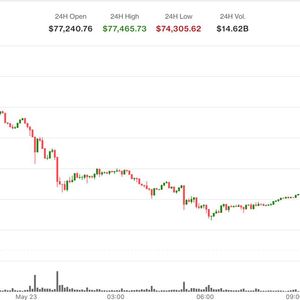
Bitcoin tanks to $74,300 as spot ETFs bleed $2.26 billion in two weeks
What happened
Over the past fortnight, the highly anticipated U.S. spot Bitcoin Exchange-Traded Funds (ETFs) experienced significant outflows, totalling more than US$2.26 billion. This substantial capital movement has coincided with a notable downturn in Bitcoin's price, leading to a broader market re-evaluation among investors globally. The approval of these spot Bitcoin ETFs earlier this year was widely heralded as a landmark event, expected to usher in a new era of institutional investment and drive price appreciation.
However, the recent data suggests a more nuanced picture. While the initial months saw strong inflows, indicating robust demand, the sustained outflows over this two-week period signal a shift in investor sentiment, at least for a segment of the U.S. market. This financial ebb and flow in a prominent jurisdiction like the United States often sends ripples across international crypto markets, including Australia, due to Bitcoin's decentralised and globally traded nature.
Why it matters for Australian investors
For Australian investors, the performance of U.S. spot Bitcoin ETFs is a critical indicator, even though direct access to these specific products may be limited. The U.S. market is a significant driver of global crypto sentiment and price action. Major shifts in institutional participation or broader investor confidence there can directly influence Bitcoin's price on Australian exchanges like CoinSpot, Independent Reserve, Swyftx, and BTC Markets.
While Australia has its own regulatory landscape, including oversight from ASIC and AUSTRAC, and a clear tax treatment framework from the ATO, the underlying asset's global price dynamics remain paramount. A downturn driven by U.S. ETF outflows can present both challenges and potential opportunities, depending on an individual investor's strategy. It underscores the interconnectedness of the global cryptocurrency ecosystem.
Australian investors holding Bitcoin, or considering new entries, should monitor these international trends closely. While local factors, such as AUD exchange rates and specific Australian market demand, always play a role, the macro movements emanating from large markets like the U.S. are often foundational in setting the overall market tone. This situation highlights the importance of a diversified and informed approach to crypto investment, considering both local and international influences.
Impact on the AUD market
The recent Bitcoin price decline, influenced by the U.S. ETF outflows, has been reflected in the AUD-denominated Bitcoin market. Australian investors would have observed a corresponding depreciation in the value of their Bitcoin holdings when priced against the Australian dollar. This direct correlation is expected, given Bitcoin's role as a global asset, with price discovery often originating from major fiat currency pairs like USD/BTC.
Local exchanges and over-the-counter (OTC) desks in Australia will adjust their AUD pricing in real-time to reflect these global movements. While the AUD/USD exchange rate can buffer or amplify the effect slightly, the primary driver for Bitcoin's AUD value remains its USD value. Therefore, any significant sustained outflow from large, regulated U.S. investment vehicles inevitably pressures the asset's price across all markets.
This scenario also impacts investor behaviour within Australia. Some HODLers might view the dip as a buying opportunity, accumulating more Bitcoin at a lower AUD cost. Conversely, others might consider it a signal for caution, potentially leading to increased selling pressure on Australian platforms. Regardless, the event reinforces that even in a distinct market like Australia, global macro crypto events have a tangible and immediate impact on local portfolios.
What to watch next
Moving forward, Australian investors should closely monitor several key indicators. The immediate focus will be on whether the U.S. spot Bitcoin ETFs reverse their outflow trend and begin to see renewed capital inflows. A sustained period of positive inflows could stabilise Bitcoin's price and potentially trigger a recovery.
Additionally, keep an eye on broader macroeconomic data, particularly U.S. inflation figures and Federal Reserve interest rate policy, as these factors heavily influence investor appetite for risk assets like Bitcoin. Any shifts in global regulatory sentiment, especially from major jurisdictions, could also impact market dynamics.
Locally, observe trading volumes on Australian exchanges and any commentary from Australian financial regulators like ASIC regarding cryptocurrency products. While the current situation is largely driven by external factors, the capacity for the Australian market to absorb, react to, and potentially decouple from global trends (albeit temporarily) is worth noting. Ultimately, understanding these interplay of global and local factors will be key to navigating the evolving cryptocurrency landscape.
Coins covered

Common questions
How do U.S. Bitcoin ETF outflows affect Australian crypto investors?
Outflows from U.S. Bitcoin ETFs typically lead to a decrease in Bitcoin's global price. Since Australian exchanges price Bitcoin based on these international market rates, Australian investors will see the value of their Bitcoin holdings, or the price they pay for new Bitcoin, fall in AUD terms. It highlights the interconnectedness of the global crypto market.
Can I invest in U.S. spot Bitcoin ETFs from Australia?
Direct investment in U.S. spot Bitcoin ETFs may be restricted for Australian retail investors due to cross-border regulatory differences. However, some Australian investors may access global markets via brokers offering international trading, or through alternative regulated crypto investment products available in Australia that track Bitcoin's price. Always consult a financial professional regarding such options.
What is the ATO's stance on Bitcoin price drops for tax purposes?
The Australian Taxation Office (ATO) views cryptocurrency as a form of property for tax purposes. If the value of your Bitcoin drops but you continue to hold it, no immediate tax event occurs. A capital gains tax event only arises when you dispose of your Bitcoin (e.g., sell it for AUD, trade it for another crypto, or use it to buy goods/services). If you sell at a loss, you may incur a capital loss that can be offset against capital gains.
U.S. spot Bitcoin ETF outflows signal a shift in crypto markets. CoinPulse AU analyses what this means for Australian investors and the AUD market.