
Bitcoin slides to April lows as crypto diverges from record-chasing U.S. equities
What happened
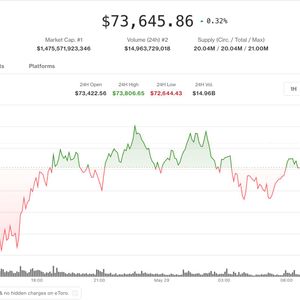
Bitcoin, the leading cryptocurrency by market capitalisation, recently experienced a notable decline, dropping to levels last seen in April. This downward movement transpired even as traditional financial markets in the United States, specifically the S&P 500 and Nasdaq futures, continued their ascent, approaching record-high valuations. The divergence between these two asset classes is a key point of observation for investors globally, including those in Australia.
Historically, there have been periods where Bitcoin's price movements showed some correlation with major stock market indices. However, recent trends suggest a decoupling, with Bitcoin facing headwinds while U.S. equities demonstrate resilience. This shift raises questions about the evolving dynamics between digital assets and traditional financial instruments, prompting market participants to reassess their investment strategies.
Several factors can contribute to such price movements in the volatile cryptocurrency market. These often include macroeconomic indicators, regulatory developments, shifts in market sentiment, and large-scale liquidations. The specific impetus for Bitcoin's recent pullback is multi-faceted, reflecting the complex interplay of these elements within the broader digital asset ecosystem.
This latest dip has seen Bitcoin's price fail to sustain an upward trajectory, particularly after an attempt to break above the USD $83,000 threshold. The inability to consolidate above this level proved significant, leading to a subsequent price correction. Such failures to maintain key resistance levels are often interpreted by technical analysts as potential indicators of weakened buying pressure and increased selling activity.
Why it matters for Australian investors
For Australian investors, the performance of Bitcoin and the broader cryptocurrency market holds significant implications. Many Australians have diversified their portfolios to include digital assets, viewing them as potential growth opportunities or hedges against traditional market volatility. A substantial price drop in Bitcoin can, therefore, impact the overall value of their crypto holdings and influence future investment decisions.
Australian investors access cryptocurrencies through various local exchanges such as CoinSpot, Independent Reserve, Swyftx, and BTC Markets. The AUD pricing of Bitcoin on these platforms directly reflects global price movements, adjusted for exchange rates and local market liquidity. A global downturn in Bitcoin's value will immediately translate to a lower AUD price, affecting both individual investors and institutional participants.
Furthermore, the Australian Taxation Office (ATO) treats cryptocurrency as property for capital gains tax purposes. Any significant fluctuations in Bitcoin's AUD value can have material implications for tax calculations, particularly for those who have bought or sold during periods of high volatility. Understanding the timing and magnitude of these price changes is crucial for accurate tax reporting.
Local regulatory bodies like AUSTRAC, which oversees anti-money laundering and counter-terrorism financing for digital currencies, and ASIC, which has a remit over financial products and services, continuously monitor the crypto landscape. While not directly influencing price, their oversight provides a framework that, in turn, can affect market confidence and investor behaviour within the Australian context. Sustained market downturns might also invite increased regulatory scrutiny, impacting how services are offered locally.
Impact on the AUD market
The Australian dollar (AUD) cryptocurrency market is not isolated from global price trends. When Bitcoin experiences a significant dip internationally, its AUD-denominated value on Australian exchanges follows suit. This direct correlation means that Australian investors holding Bitcoin see an immediate depreciation in their portfolio's value in their local currency.
Market sentiment in Australia often mirrors global trends, although local factors can sometimes introduce nuances. A sharp decline in Bitcoin prices might lead to increased selling pressure on Australian exchanges as some investors try to mitigate losses. Conversely, others might view it as a buying opportunity, potentially increasing trading volumes.
For businesses and individuals with exposure to cryptocurrency in Australia, such as those accepting Bitcoin for payments or holding it as a treasury asset, a price slump can affect their balance sheets and operational revenue. While the Australian market is relatively small compared to global giants, its participants are keenly aware of these international shifts.
Moreover, the performance of major cryptocurrencies like Bitcoin can influence the perceived risk appetite of Australian investors towards digital assets generally. A sustained period of price weakness could lead to a more cautious approach, potentially slowing the adoption of newer altcoins or decentralised finance (DeFi) products within the Australian investor community.
What to watch next
Looking ahead, Australian investors should closely monitor several key indicators. The trend of divergence between Bitcoin and traditional U.S. equities will be a critical area of focus. If this pattern continues, it suggests that Bitcoin's market drivers are becoming increasingly distinct from those influencing the broader stock market, necessitating a fresh analytical approach.
Another crucial aspect to watch is the price movement around key technical support and resistance levels. A sustained break below major support could signal further downside potential, while a successful breach and hold above resistance could indicate a turnaround. These technical indicators are often closely watched by Australian traders utilising platforms that offer advanced charting tools.
Furthermore, global macroeconomic developments, particularly interest rate decisions from major central banks and inflation data, will likely continue to influence investor sentiment towards risk assets like Bitcoin. Australian investors should also keep an eye on any new regulatory announcements from AUSTRAC or ASIC, as these can shape the operational environment for crypto businesses and indirectly influence market confidence.
Finally, the actions of large institutional investors and high-net-worth individuals, often referred to as 'whales', can significantly impact Bitcoin's price due to their substantial holdings. Monitoring on-chain data for large movements of Bitcoin in or out of exchanges can provide early signals of potential selling or accumulation trends that Australian investors can factor into their strategies. The evolving narrative around Bitcoin's role in a diversified portfolio, especially in local financial planning discussions, will also be influential.
Coins covered

Common questions
How does Bitcoin's price drop affect my crypto holdings on Australian exchanges?
When Bitcoin's global price declines, its value on Australian exchanges like CoinSpot, Independent Reserve, Swyftx, and BTC Markets will also fall, as these platforms reflect the international market price converted to AUD. This means the AUD value of your holdings will decrease.
What are the tax implications in Australia if my Bitcoin value decreases?
For Australian tax purposes, cryptocurrency is generally treated as property for Capital Gains Tax (CGT). If your Bitcoin value decreases but you do not sell it, there is typically no immediate tax event. However, if you sell your Bitcoin at a loss, you may be able to use that capital loss to offset other capital gains, subject to ATO rules. It's best to consult a tax professional for personalised advice.
Should Australian investors be cautious about buying Bitcoin if it's diverging from the stock market?
The divergence of Bitcoin from traditional markets highlights its unique risk profile. While some investors may see a dip as a buying opportunity, others may view it as a signal for caution. Australian investors should conduct their own research, understand market volatility, and align any investment decisions with their personal financial goals and risk tolerance. This is not financial advice.
Bitcoin's recent slide to April lows signals a divergence from surging U.S. equities. CoinPulse AU analyses what this means for Australian crypto investors.