
Bitcoin caught between critical onchain support and an options showdown
What happened
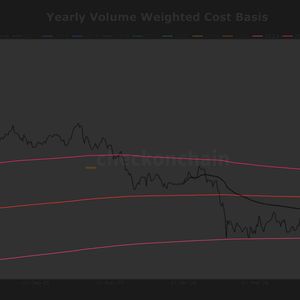
Bitcoin's price has recently experienced a period of suppressed volatility, with its value largely trading within a defined range. This market behaviour is primarily attributed to two significant on-chain factors. Firstly, there's a substantial concentration of Bitcoin supply held by long-term holders and institutional entities, which indicates strong underlying conviction but also limits readily available tokens for significant price swings.
Secondly, the cryptocurrency options market is playing a crucial role. A substantial volume of options contracts, particularly those with upcoming expiry dates, appears to be acting as both a floor and a ceiling for Bitcoin's price. Major expiry events often coincide with reduced volatility as market participants hedge positions, leading to a 'max pain' scenario where the price hovers around a level that liquidates the fewest options contracts.
This confluence of factors suggests a market in equilibrium, albeit one characterised by low-volume price action. While some might view this as stagnation, others see it as a period of consolidation. The market is effectively 'coiling,' absorbing supply and demand pressures within a relatively tight band, awaiting a catalyst for a more decisive move. This dynamic is not uncommon in mature asset classes, but it's a significant development for a typically volatile asset like Bitcoin.
This sustained period of range-bound trading suggests that neither bullish nor bearish forces have been able to gain a definitive upper hand. Large option positions are essentially 'pinning' the price, preventing significant breakouts in either direction. For Bitcoin, an asset often defined by its dramatic price movements, this quiet period presents a unique phase for analysis and strategic planning.
Why it matters for Australian investors
For Australian Bitcoin investors, understanding these market dynamics is crucial. While the global Bitcoin price dictates much of its value here, local factors can influence how investors perceive and interact with the asset. A period of low volatility, for instance, might reduce the appeal for short-term traders looking for rapid gains, but it could conversely offer a more stable entry or accumulation point for long-term holders.
AUSTRALIAN exchanges like CoinSpot, Independent Reserve, Swyftx, and BTC Markets all list Bitcoin, and their users are directly impacted by these global trends. While the AUD/USD exchange rate always plays a role in the local Bitcoin price (e.g., if global BTC is $30,000 USD, its AUD value fluctuates with the AUD/USD rate), the underlying USD-denominated Bitcoin behaviour is the primary driver. This current subdued volatility translates directly into quieter markets on these Australian platforms.
Moreover, the ATO's guidance on cryptocurrency as an asset for capital gains tax purposes means that the timing of investments and disposals is highly relevant. A sideways market may offer less opportunity for significant short-term capital gains, but equally, it reduces the risk of substantial short-term losses. Investors should continue to track the AUD-denominated price on their chosen Australian exchange.
This current market phase might also be a good time for Australian investors to review their portfolio allocations and risk management strategies. The stability, even if temporary, allows for more deliberate decision-making rather than reactive trading. Considering the ongoing evolution of crypto regulation in Australia, including potential actions from ASIC and AUSTRAC, maintaining a clear understanding of market conditions is paramount.
Impact on the AUD market
The range-bound nature of Bitcoin's price directly influences the Australian dollar (AUD) cryptocurrency market. When Bitcoin's volatility is suppressed globally, the AUD-denominated price also tends to stabilise, assuming the AUD/USD exchange rate remains relatively steady. This can lead to reduced trading volumes on Australian exchanges as speculative activity decreases.
Local investors often look for opportunities in volatility, so a stable Bitcoin price might encourage them to explore other digital assets or even traditional markets. Conversely, for those using Bitcoin as a hedge against inflation or as a long-term store of value, this period of consolidation could be viewed positively, as it reduces immediate draw-down risks.
The activity on Australian exchanges predominantly mirrors global sentiment. If institutional interest globally is causing a significant supply concentration, Australian investors are indirectly benefiting from (or contributing to) this underlying market structure. The perceived stability, even if driven by complex options market dynamics, can foster greater mainstream acceptance and potentially attract more traditional Australian investors who are wary of extreme price swings.
Furthermore, liquidity providers and market makers on Australian platforms will adjust their strategies based on this reduced volatility. Spreads might tighten slightly, and trading bots may operate within narrower parameters. This all contributes to a calmer, albeit potentially less exciting, trading environment for AUD-based crypto participants. It reinforces the idea that even in a global asset, local market conditions and investor psychology play a role in interpretation and reaction.
What to watch next
The key factor to watch moving forward will be the resolution of these on-chain and options-driven pressures. As major options expiry dates pass, the 'pinning' effect could diminish, potentially allowing Bitcoin to break out of its current range. Traders will be closely monitoring open interest in future options contracts for clues about potential future price targets or resistance levels.
Beyond options, observing the behaviour of long-term holders and institutional movements will be crucial. Any significant shift in their accumulation or distribution patterns could signal a change in the supply concentration. An increased willingness to sell by these entities could lead to downward pressure, while continued strong holding could provide a base for an eventual ascent.
Global macroeconomic developments will also continue to play a significant role. Interest rate decisions by major central banks, inflation data, and broader economic sentiment can all influence investor appetite for risk assets like Bitcoin. For Australian investors, the Reserve Bank of Australia's (RBA) stance on monetary policy and the performance of the Australian economy will also be important considerations.
Finally, significant technological upgrades or regulatory announcements related to Bitcoin or the broader crypto ecosystem could act as catalysts. While a 'spot Bitcoin ETF' has been a global focus, any new regulatory clarity from bodies like ASIC or AUSTRAC regarding crypto products in Australia could also inject new interest or confidence into the local market. Maintaining a vigilant watch on both technical indicators and fundamental news will be key to navigating the next phase of Bitcoin's price action.
Coins covered

Common questions
How does Bitcoin's global price range affect its value on Australian exchanges?
Bitcoin's AUD price on Australian exchanges like CoinSpot and Swyftx is directly derived from its global USD price, adjusted by the prevailing AUD/USD exchange rate. So, if Bitcoin is trading within a narrow range globally, its AUD value will experience similar subdued volatility, assuming the Australian dollar's value against the US dollar remains relatively stable.
What does suppressed volatility mean for my ATO tax obligations on Bitcoin?
Suppressed volatility generally means fewer dramatic price swings, which might result in fewer significant capital gains or losses in the short term. However, any gain or loss from selling, swapping, or using Bitcoin is a capital event in Australia and must be reported to the ATO, regardless of the size. It simply means the magnitude of those gains or losses might be smaller during such periods.
Should Australian investors be concerned about on-chain supply concentration?
On-chain supply concentration, especially by long-term holders, can indicate strong conviction in Bitcoin's future value. For Australian investors, this can be seen as a positive sign of underlying strength, potentially reducing the likelihood of large sell-offs. However, it also means less circulating supply, which can contribute to periods of low liquidity and reduced price action, as seen recently.
Explore how Bitcoin's current market dynamics, driven by on-chain supply and options, impact Australian investors. CoinPulse AU analyses why BTC's range-bound