
Tether Faces $344M Stablecoin Seizure Bid as Myanmar Eyes Death Penalty and CLARITY Act Advances
AI-summarised from reporting by CoinOtag. How we use AI.
What happened
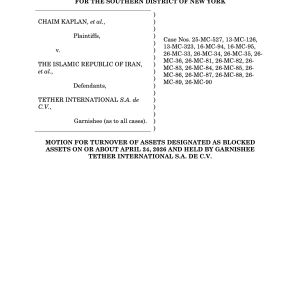
A US law firm, Free Speech For Health (FSFH), recently escalated its legal campaign by filing a motion to seize approximately US$344 million in Tether (USDT) stablecoins. This action targets funds currently frozen on the Ethereum and Tron blockchains. The firm is seeking to redirect these blockchain-based assets to satisfy unrelated legal judgments, specifically a US$1.1 billion default judgment against a darknet market for fentanyl distribution.
This legal manoeuvre effectively demands that Tether, the issuer of the USDT stablecoin, hand over or "claw back" the specified amount. It highlights a burgeoning legal frontier where traditional legal systems are attempting to assert jurisdiction over decentralised digital assets. The precedent set by such actions could have far-reaching implications for how frozen or illicitly obtained crypto assets are handled globally.
Simultaneously, the CLARITY Act is advancing in the US, a bipartisan bill aimed at providing a regulatory framework for stablecoins. This proposed legislation seeks to define stablecoins, establish parameters for their issuance, and mandate regular audits and reserve disclosures.
The CLARITY Act's progression signals a growing intent by US lawmakers to bring stablecoins under a more formal regulatory umbrella. This move is driven by concerns over financial stability, consumer protection, and illicit finance. The proposed regulations could significantly impact how stablecoins operate, requiring greater transparency and potentially linking them more closely to traditional financial systems.
Why it matters for Australian investors
For Australian investors, the developments surrounding Tether and stablecoin regulation in the US are highly significant. Tether (USDT) is one of the most widely used stablecoins globally, actively traded on major Australian crypto exchanges like CoinSpot, Independent Reserve, Swyftx, and BTC Markets. Any action affecting Tether's stability or its operational framework has direct repercussions for portfolio valuations and trading strategies locally.
The seizure attempt raises questions about the security and immutability of digital assets, even stablecoins, when faced with powerful legal mandates. Australian investors holding USDT might consider the implications of such legal overreach, particularly regarding the potential for assets to be frozen or seized based on third-party actions not directly related to them. Diversification of crypto holdings and understanding the nature of different stablecoin collateralisation remain crucial.
Furthermore, the progression of the CLARITY Act in the US could set a global precedent for stablecoin regulation. While Australia has its own regulatory roadmap, including proposals from Treasury and ASIC for digital assets, US legislative developments often influence international standards. Tighter US regulations could lead to increased compliance costs for stablecoin issuers, potentially affecting liquidity or access for Australian users.
AUSTRAC, Australia's financial intelligence agency, already has robust frameworks for anti-money laundering and counter-terrorism financing that apply to digital currency exchanges. Should global stablecoin regulations tighten, Australian exchanges might face heightened reporting requirements, impacting transaction times or verification processes for users. The ATO also monitors crypto transactions closely, and regulatory clarity often assists in tax compliance.
Impact on the AUD market
The Australian dollar (AUD) market for cryptocurrencies is inextricably linked to global stablecoin dynamics. USDT often serves as a primary liquidity pair for many cryptocurrencies traded against AUD on local exchanges. A significant event impacting Tether's perceived stability or its operational capabilities could trigger market volatility across various AUD-denominated crypto pairs.
If the US$344 million seizure attempt against Tether were to succeed or generate substantial uncertainty, it could lead to a 'de-pegging' event for USDT, even temporarily. While Tether has historically maintained its peg effectively, a large-scale legal challenge could erode investor confidence. Such an event would likely cause a flight to quality, potentially benefiting other stablecoins or even traditional fiat conversions, including AUD.
Australian investors regularly use USDT to arbitrage between exchanges or to park funds during volatile periods without exiting the crypto ecosystem entirely. Any disruption to USDT's functionality or perceived reliability could complicate these strategies, forcing a reassessment of risk and liquidity management within AUD crypto portfolios.
Moreover, increased regulatory clarity, as aimed for by the CLARITY Act, could ultimately foster greater institutional adoption and stability in the stablecoin market. For the AUD crypto market, this might translate into more institutional participation, potentially increasing liquidity and reducing volatility over the long term. However, the initial phase of regulatory implementation often introduces uncertainty.
What to watch next
Australian investors should closely monitor the outcome of the legal motion against Tether in the US courts. The precedent set by whether crypto assets can be seized to satisfy unrelated judgments will be critical for the broader digital asset landscape. Keep an eye on any official statements or responses from Tether regarding its defence strategies and its ability to withstand such legal pressures.
The progression of the CLARITY Act in the US Congress is another key area to watch. Its journey through legislative hurdles and eventual implementation will shape the future regulatory environment for stablecoins. Any specific provisions concerning reserve requirements, auditing standards, or enforcement mechanisms will be highly relevant for Australian investors and businesses operating in the digital asset space.
Observe how Australian regulators and policymakers respond to these international developments. Treasury, ASIC, and AUSTRAC are all engaging with digital asset regulation, and global trends often influence local policy. Look for any statements or guidance from these bodies that clarify Australia's stance on stablecoins and the enforceability of foreign legal judgments regarding digital assets.
Finally, continue to monitor liquidity and trading pairs involving USDT on Australian exchanges. Any significant divergence in USDT's peg to the US dollar, or changes in trading volumes on platforms like CoinSpot, Independent Reserve, Swyftx, and BTC Markets, could be early indicators of market sentiment shifts. Diversifying stablecoin exposure and staying informed on regulatory changes will be prudent for savvy Australian investors.
Coins covered




Common questions
How does the proposed seizure of Tether (USDT) funds affect Australian crypto investors?
While the legal action is in the US, Australian investors holding USDT could be indirectly affected by its outcome. If a precedent is set allowing large-scale seizures, it could raise concerns about the security of all stablecoins and potentially impact liquidity or market confidence on Australian exchanges like CoinSpot or Swyftx. It reinforces the importance of understanding the risks associated with stablecoin holdings.
What regulatory changes could Australian stablecoin investors see following the CLARITY Act in the US?
Although the CLARITY Act is a US bill, its potential passage could set a global benchmark for stablecoin regulation. This might influence Australian regulators, such as ASIC or Treasury, to accelerate or adapt their own regulatory frameworks for digital assets and stablecoins, potentially leading to increased reporting requirements for Australian exchanges and greater transparency mandates for stablecoin issuers operating in Australia, impacting AUD trading pairs.
Are my stablecoin holdings on Australian exchanges like BTC Markets or Independent Reserve exposed to similar legal risks?
Australian exchanges operate under Australian law, including AUSTRAC's anti-money laundering regulations. While foreign legal actions don't directly apply to assets held on Australian-regulated platforms in the same way, global legal precedents and regulatory shifts can influence the broader crypto ecosystem. Investors should stay informed about both international and local regulatory developments, and understand that all crypto assets carry inherent risks.
A US legal bid targets US$344M Tether (USDT) funds while the CLARITY Act advances. Australian investors: understand the impact on stablecoin holdings and loca
About this article: this is an AI-generated summary of reporting by CoinOtag. It has not been reviewed by a human editor. We use AI to localise crypto news for Australian readers, and we link back to the original source so you can verify the facts.
Informational only — not financial advice. Always do your own research. Read our AI & editorial policy →