
Pi Network (PI) Price Predictions for This Week, May 20
What happened
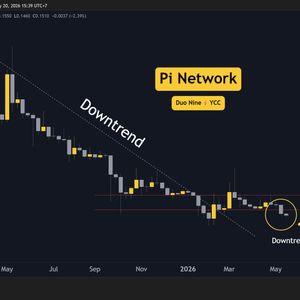
Recent trading activity for Pi Network (PI) has seen a significant shift, with sellers gaining the upper hand. Over the past week, intense selling pressure has driven the price of PI below a crucial support level. This development has raised concerns among market observers regarding the asset's short-term trajectory.
The key support level at $0.16, which had previously offered a floor for PI's price, ultimately buckled under the sustained pressure. This $0.16 mark now acts as a resistance level, indicating a change in market dynamics. The breakdown could signal a return to a broader downtrend that had paused since February, when PI began a period of sideways trading.
Following the breach of $0.16, bears pushed the price further down to the $0.15 level. Buyers have shown some interest at this point, attempting to establish a new foothold. However, the accompanying buy volume appears to be low, suggesting a lack of strong conviction from purchasers. Should buyers fail to exert significant upward pressure, PI faces the prospect of retesting its all-time low at $0.13.
Compounding the bearish sentiment, the daily Relative Strength Index (RSI) for PI has dipped below 30, entering what is typically considered an oversold territory. Historically, an oversold RSI can precede a price bounce as sellers may temporarily exhaust their pressure. While this might offer a brief respite for PI buyers, any rebound could be short-lived, with a larger test of the $0.13 support level still anticipated.
Why it matters for Australian investors
For Australian investors watching the global crypto market, the performance of assets like Pi Network (PI) can offer insights into broader market sentiment, even if PI is a nascent project with limited exchange listings. While specific AUD pricing for PI might not be readily available on major Australian exchanges such as CoinSpot, Independent Reserve, Swyftx, or BTC Markets, understanding its price movements remains relevant.
Such downtrends highlight the inherent volatility of cryptocurrency investments, a factor Australian investors must always consider. The potential for a retest of all-time lows underscores the high-risk nature of newer or less established digital assets. Prudent Australian investors often diversify their portfolios and conduct thorough due diligence before committing capital to such projects.
Furthermore, the tax implications for any realised gains or losses remain a critical consideration. The Australian Taxation Office (ATO) treats cryptocurrency as property for capital gains tax (CGT) purposes. Therefore, any profit made from selling PI, or any digital asset, would be subject to CGT, while losses can be used to offset future capital gains. Keeping accurate records of transactions, including acquisition costs and disposal prices, is essential for ATO compliance.
The regulatory landscape in Australia, overseen by bodies like AUSTRAC for anti-money laundering (AML) and counter-terrorism financing (CTF) and ASIC for consumer protection, continues to evolve. While projects like Pi Network are still largely in development phases and may not be directly under the purview of these regulators in the same way established assets are, the underlying principles of market stability and investor protection are paramount.
Impact on the AUD market
In the immediate term, the price action of Pi Network (PI) is unlikely to have a direct, significant impact on the broader Australian dollar (AUD) cryptocurrency market. PI is not widely traded on Australian-regulated exchanges, and its market capitalisation is not substantial enough to create ripple effects across more liquid AUD-denominated pairs like BTC/AUD or ETH/AUD.
However, persistent bearish trends in newer, high-potential projects can contribute to a general sentiment of caution among Australian crypto investors. If several emerging digital assets face similar downward pressure, it could lead to reduced appetite for riskier, less established cryptocurrencies across the AUD market. This might see capital flow into more established assets or even out of the crypto market entirely.
For Australian exchanges, the market activity of assets like PI serves as a reminder of the need for robust listing criteria and risk management. While they might not list PI, the performance of such assets influences investor behaviour and confidence which, in turn, can affect trading volumes and participation on their platforms. Maintaining transparency and offering educational resources for investors remain key prerogatives for these platforms.
Developers and innovators in the Australian blockchain space might also observe these trends. The challenges faced by projects like Pi Network highlight the competitive nature of the digital asset landscape and the importance of delivering tangible utility and adoption. This reinforces the need for Australian blockchain projects to focus on sustainable growth models and clear value propositions to attract and retain investor interest.
What to watch next
The immediate focus for Pi Network (PI) remains the critical $0.13 level. A decisive break below this all-time low would confirm a strong bearish continuation and could pave the way for further price degradation. Conversely, a sustained bounce from current levels, particularly if accompanied by increased buying volume, would challenge the prevailing bearish sentiment.
Investors should closely monitor the daily RSI. While currently oversold, a failure to bounce significantly from this level, or a rapid re-entry into oversold territory after a brief upswing, would signal continued seller dominance. A strong reversal, however, could be indicated by the RSI moving back towards the neutral 50-mark.
Beyond technical indicators, broader market sentiment for altcoins will play a role. If major cryptocurrencies experience sustained upward momentum, it could provide a tailwind for smaller projects like PI, potentially enabling a bounce. Conversely, a downturn in the general crypto market could exacerbate PI's current struggles.
Finally, any news or updates from the Pi Network development team regarding mainnet launch, utility, or new partnerships could significantly influence sentiment and price action. While the market frequently reacts to technicals, fundamental developments often provide the catalyst for more profound and lasting price movements. Australian investors should look for genuine progress rather than speculative hype when evaluating such projects.
Coins covered



Common questions
How does the ATO tax Pi Network (PI) if it's not yet widely traded on Australian exchanges?
The Australian Taxation Office (ATO) treats all cryptocurrency as property for capital gains tax (CGT) purposes. If you were to acquire or dispose of Pi Network (PI), regardless of where it's listed, any capital gain or loss would typically be subject to CGT. It's crucial to keep diligent records of your acquisition date, cost, and disposal details for all cryptocurrency transactions to ensure compliance.
Can I buy Pi Network (PI) on Australian exchanges like CoinSpot or Swyftx?
As of now, Pi Network (PI) is not widely available on major regulated Australian cryptocurrency exchanges such as CoinSpot, Independent Reserve, Swyftx, or BTC Markets in its tradable form. Its availability is typically associated with its ongoing 'mining' process within the Pi Network app, and its listing on open exchanges is pending the full launch of its mainnet.
What regulatory oversight does Pi Network (PI) have in Australia?
The regulatory landscape for newer, less established cryptocurrencies like Pi Network (PI) in Australia is complex. While AUSTRAC oversees anti-money laundering (AML) and counter-terrorism financing (CTF) for digital currency exchanges, and ASIC focuses on consumer protection, Pi Network itself is largely still in a developmental phase. Direct regulatory oversight would likely apply more robustly once PI is widely traded on regulated platforms or offered as a financial product.
Pi Network (PI) faces significant selling pressure and key support breaches. Australian investors consider impact on volatility and ATO tax implications.