
Filecoin (FIL) And Kaspa (KAS): As On‑Chain Storage And Faster POW Rails Both Get Attention, Do FIL And KAS Form A “Data + Settlement” Pair For Infrastructure T...
AI-summarised from reporting by Bitzo. How we use AI.
What happened
The digital asset market is currently witnessing a significant repricing of foundational infrastructure protocols. As artificial intelligence models demand increasingly vast and verifiable datasets, and retail users seek scalable, non-EVM (Ethereum Virtual Machine) settlement networks, two distinct protocols have garnered considerable attention: Filecoin (FIL) and Kaspa (KAS).
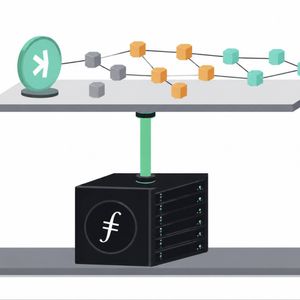
These two assets represent complementary yet distinct ends of the blockchain infrastructure spectrum. Filecoin is designed as a decentralised storage network, crucial for housing the monumental Web3 archives and the extensive datasets required for AI training. Kaspa, on the other hand, provides an ultra-fast, Proof-of-Work (PoW) settlement layer, specifically optimised for high-frequency micro-payments and its burgeoning KRC-20 token ecosystem.
Despite their foundational importance, a close examination of their 30-day technical structures reveals both FIL and KAS are currently navigating mid-cycle consolidation ranges. This has prompted market participants to ponder whether this period represents a quiet accumulation phase for a potentially powerful "Data + Settlement" infrastructure pairing, or merely a temporary pause within a broader market cool-down.
Filecoin has evolved significantly, transitioning from a simple storage network to a fully programmable layer through the Filecoin Virtual Machine (FVM). This upgrade underscores its vital role in the decentralised data landscape, especially for AI applications. However, its price action suggests the market is yet to find a definitive trend, hovering between key resistance and support levels.
Kaspa has attracted attention as a scalable, fair-launch PoW alternative, particularly with the introduction of its KRC-20 token standard, which brings smart-contract-like functionality to its blockDAG architecture. Its recent price action has been more contained than Filecoin's, experiencing a gentle pullback after a modest climb, rather than the sharper volatility seen in FIL.
Why it matters for Australian investors
For Australian crypto investors, understanding the movements of foundational infrastructure tokens like FIL and KAS is crucial. While not directly linked to specific Australian economic indicators, the performance of these core protocols can influence the broader market sentiment and the viability of decentralised applications that Australian users might engage with.
Filecoin's role in decentralised data storage has implications for data sovereignty and security, which are growing concerns globally, including in Australia. As businesses and individuals in Australia increasingly adopt Web3 technologies, the demand for verifiable and robust storage solutions could impact FIL's long-term utility and value.
Kaspa's focus on fast, scalable PoW settlement offers an alternative to dominant networks. For Australian investors considering diversification beyond major Proof-of-Stake (PoS) assets, or those interested in high-throughput transaction networks, KAS presents an interesting case study. Its KRC-20 ecosystem could host decentralised finance (DeFi) or gaming applications relevant to Australian users.
The consolidation phases observed in both tokens highlight the speculative nature of infrastructure plays. Australian investors should be mindful of the regulatory environment, with organisations like AUSTRAC providing guidance on digital asset transactions and the ATO specifying tax treatments for crypto holdings. Such considerations are paramount when evaluating potential long-term investments in this space.
Impact on the AUD market
While Filecoin and Kaspa do not have direct AUD pairings on major Australian exchanges like CoinSpot, Independent Reserve, Swyftx, or BTC Markets, their performance can indirectly influence the AUD crypto market through shifts in overall market capitalisation and investor sentiment. Australian investors typically convert AUD to stablecoins or major cryptocurrencies like Bitcoin (BTC) or Ethereum (ETH) before trading for FIL or KAS on international platforms.
Significant price movements in these foundational infrastructure tokens can ripple through the broader crypto ecosystem. A strong uptrend in FIL or KAS, particularly if driven by fundamental adoption, could signal a healthy demand for decentralised infrastructure, potentially boosting confidence across the market. This renewed confidence might translate into increased trading volumes or interest in other altcoins available on Australian exchanges.
Conversely, prolonged range-bound trading or a significant price downturn could contribute to a more cautious sentiment among Australian investors. Given that Australian regulators like ASIC are increasingly scrutinising crypto products, the stability and utility of underlying protocols gain importance. Investors may prefer assets with clearer use cases and less volatile price action.
Furthermore, the tax implications for Australian investors holding assets like FIL and KAS are significant. Any capital gains or losses from trading these tokens must be declared to the ATO. This national context means that even for globally traded assets, the local financial landscape plays a critical role in investment decisions and overall impact on the Australian digital asset market.
What to watch next
For Filecoin, the immediate focus is its ability to defend the $0.92 support floor. A daily close below this level would unwind its recent gains and suggest a lack of buyer conviction. To signal a sustained uptrend, FIL needs to reclaim and hold the $1.10 level on substantial trading volume, demonstrating that demand can overcome the overhead resistance near its short-term Simple Moving Average (SMA) proxy at $1.00.
Another key metric for FIL will be tangible growth in enterprise data onboarding via its FVM. Increased real-world utility and adoption, rather than just speculative trading, will be vital for a breakout. Australian investors should monitor reports on Filecoin's partnerships and usage statistics as indicators of its fundamental strength.
For Kaspa, the critical thresholds are its 30-day swing low at $0.0325 and the immediate resistance band of $0.036 to $0.037. Losing the $0.0325 floor would indicate a deeper correction than the current gentle pullback. A break above $0.037, combined with increased transaction velocity from KRC-20 token deployments, would provide a strong bullish signal.
Both tokens currently reside in a "wait-and-see" market. For them to solidify their position as a compelling "Data + Settlement" pair, they would need to demonstrate simultaneous technical strength and fundamental adoption. Australian investors should observe whether FIL can break its consolidation with enterprise growth and whether KAS can increase transaction throughput, suggesting a synergistic relationship rather than just independent movements.
Coins covered





Common questions
How does the ATO tax Filecoin (FIL) or Kaspa (KAS) for Australian investors?
For Australian investors, the ATO generally treats cryptocurrencies like Filecoin (FIL) and Kaspa (KAS) as a form of property for tax purposes. This means that if you sell, swap, or otherwise dispose of FIL or KAS, any capital gains or losses will typically need to be declared in your tax return. Short-term gains (assets held for less than 12 months) are taxed at your marginal income tax rate, while long-term gains (assets held for 12 months or more) may be eligible for a 50% Capital Gains Tax (CGT) discount for individuals. It's recommended to keep thorough records of all transactions.
Can I buy Filecoin (FIL) or Kaspa (KAS) directly with AUD on Australian crypto exchanges?
While major Australian crypto exchanges like CoinSpot, Independent Reserve, Swyftx, and BTC Markets offer a wide range of cryptocurrencies, direct AUD pairings for Filecoin (FIL) or Kaspa (KAS) may not always be available. Typically, Australian investors would first need to convert their AUD into a major cryptocurrency like Bitcoin (BTC) or Ethereum (ETH), or a stablecoin, and then trade for FIL or KAS on platforms that support those pairs. It's always best to check the specific listings and trading pairs available on your preferred exchange.
What role does AUSTRAC play in Australian investments in Filecoin or Kaspa?
AUSTRAC (Australian Transaction Reports and Analysis Centre) is Australia's financial intelligence agency responsible for combating money laundering and terrorism financing. For Australian investments in cryptocurrencies like Filecoin or Kaspa, AUSTRAC plays a crucial role in regulating digital currency exchanges operating in Australia. These exchanges must be registered with AUSTRAC and comply with anti-money laundering (AML) and counter-terrorism financing (CTF) obligations, which include collecting and verifying customer identity information. This regulatory oversight helps ensure the integrity of the Australian crypto market, even for assets traded globally.
Explore Filecoin (FIL) and Kaspa (KAS) for Australian investors. Deep dive into their market consolidation and what it means for decentralised storage and fas
About this article: this is an AI-generated summary of reporting by Bitzo. It has not been reviewed by a human editor. We use AI to localise crypto news for Australian readers, and we link back to the original source so you can verify the facts.
Informational only — not financial advice. Always do your own research. Read our AI & editorial policy →