
Ethereum Price Analysis: Is ETH Finally Attempting a Real Breakout?
AI-summarised from reporting by Crypto Potato. How we use AI.
What happened
Ethereum (ETH) has been navigating a turbulent period, currently trading above the US$2,200 mark as the third week of May progresses. This follows several rejections at the critical US$2,400 resistance zone, which has proven to be a formidable barrier for the leading altcoin. The aggressive long positioning that had built up in anticipation of a breakthrough at US$2,400 has largely unwound, suggesting a recalibration in market sentiment.
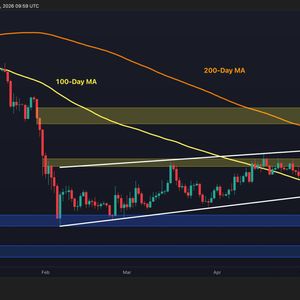
The price action indicates that further consolidation is likely in the coming days as ETH struggles to establish a clear directional bias. On the daily chart, ETH is maintaining its position above the 100-day moving average, currently hovering around US$2,150. This technical indicator offers a glimmer of positive sentiment amidst the broader uncertainty. The upward-sloping channel that originated from the February lows also remains intact, with its lower boundary rising towards US$2,100, poised to act as dynamic support.
However, the recurring rejections at US$2,400 underscore a significant supply zone. Beyond this, the 200-day moving average, positioned near US$2,600, represents the next major overhead resistance, coinciding with the higher boundary of the aforementioned channel. To build a stronger case for a sustained recovery, ETH needs to decisively surmount the US$2,400 level and subsequently reclaim the 200-day moving average. Neither of these moves appears straightforward given the current market momentum.
In the shorter term, the 4-hour chart reveals that a descending wedge, which had been compressing the price since mid-April highs, is resolving to the downside. The lower boundary, near US$2,260, has been breached, leaving ETH precariously close to the crucial US$2,200 support zone. This level has historically demonstrated resilience, acting as a bounce-off point in recent weeks. The Relative Strength Index (RSI) on this timeframe is in the 40-45 range, indicating soft momentum but not yet signalling oversold conditions that typically precede a significant bounce.
Why it matters for Australian investors
For Australian investors, the movements of Ethereum are incredibly pertinent, given its status as the second-largest cryptocurrency by market capitalisation. Its performance often influences the broader altcoin market, where many Australian portfolios hold diversified positions. The ongoing struggle around key resistance and support levels in US dollar terms directly translates into fluctuations in the Australian dollar (AUD) value of ETH, impacting local portfolio valuations.
Australian investors commonly access ETH through regulated exchanges such as CoinSpot, Independent Reserve, Swyftx, and BTC Markets. These platforms convert USD-denominated prices into AUD, meaning that any significant price shifts, up or down, are immediately reflected in their AUD holdings. Therefore, understanding the underlying USD price action and technical indicators is crucial for making informed decisions on buy, sell, or hold strategies within the Australian context.
The consolidation phase and repeated rejections at US$2,400 highlight a period of uncertainty. For Australian investors, this environment necessitates careful consideration of risk management. While the 100-day moving average and the ascending channel offer some technical support, a decisive break below the US$2,200 support or, more severely, below US$2,000, could signal a more significant downturn. Such an event would inevitably lead to a depreciation of ETH holdings in AUD terms, potentially triggering stop-losses or prompting re-evaluation of investment theses.
Furthermore, the sentiment analysis, particularly the slight uptick in exchange reserves, offers a key insight into market dynamics. The return of approximately 400,000 ETH to exchanges as the price approached US$2,400 suggests that some early accumulators are taking profits. This dynamic, where supply increases at critical resistance levels, can act as a natural ceiling. For Australian investors looking to enter or exit positions, understanding these underlying supply-demand shifts is vital, as they directly contribute to price ceiling formation and the potential for a breakout or breakdown. Australian tax obligations on crypto gains also make the timing of these moves significant, as profit-taking triggers capital gains events.
Impact on the AUD market
The immediate impact on the AUD market for Ethereum is directly tied to its US dollar valuation. When ETH struggles against significant resistance, such as the US$2,400 level, its AUD equivalent also faces downward pressure or struggles to appreciate. Australian investors checking their portfolios on local exchanges would see their ETH holdings stagnate or decrease in value, even if the AUD/USD exchange rate remains relatively stable.
A confirmed break below the critical US$2,200 support zone, or even the more significant US$2,000 psychological barrier, would have a pronounced effect. Such a move would likely lead to a substantial drop in the AUD price of ETH, potentially causing a ripple effect across the broader Australian crypto market, especially for altcoins that have a high correlation with Ethereum's performance. Investors might observe increased selling pressure on local platforms as holders seek to mitigate further losses.
Conversely, a successful rebound from the US$2,200 level or a definitive breach of the US$2,400 resistance would instil renewed confidence. This would likely translate into an uplift in AUD-denominated ETH prices, potentially attracting new investment from Australian market participants looking to capitalise on positive momentum. Local exchanges might experience increased trading volumes as both retail and institutional investors react to these shifts.
The behaviour of exchange reserves also holds relevance for the AUD market. The observed increase in ETH moving to exchanges, particularly coinciding with price approaches to US$2,400, suggests that supply is readily available at these levels. This increased supply makes upward price movements more challenging, as demand needs to absorb more selling pressure. For AUD-denominated traders, this means that even strong buying sentiment might be tempered by existing supply, requiring sustained buying strength to overcome these resistance points. The current market structure suggests that Australian investors should brace for continued choppiness in the AUD price of ETH until a clear trend emerges.
What to watch next
Moving forward, Australian investors should closely monitor several key technical levels for Ethereum. The immediate focus remains on the US$2,200 support zone. A successful rebound from this level would be crucial for maintaining any short-term bullish structure and could set the stage for another attempt at reclaiming US$2,400. Conversely, a confirmed breach below US$2,200 would open the path towards the US$2,000-$2,100 support zone, which also aligns with the daily channel's lower boundary. A drop below these levels could signal further downside risk towards US$1,800.
Sentiment analysis, particularly the trajectory of exchange reserves, will also be a critical indicator. The recent modest increase in ETH returning to exchanges, albeit small in the broader context, suggests that profit-taking from early accumulators is contributing to supply at resistance levels. For a sustained breakout above US$2,400 to materialise, this trend of increasing exchange reserves would ideally need to reverse, indicating that these holders have finished distributing their supply. A renewed decline in exchange reserves would signal a reduction in selling pressure, potentially paving the way for upward momentum.
Monitoring broader market sentiment and macroeconomic factors, both globally and within Australia, will also be important. While this analysis focuses on ETH-specifics, general crypto market movements and shifts in global economic conditions can have a significant impact. Investors should also observe regulatory developments, including potential updates from ASIC or AUSTRAC regarding cryptocurrency regulations, and how these might influence local market dynamics and investor confidence.
Ultimately, a convincing recovery for ETH hinges on two main factors: first, a decisive stabilisation and close above the persistent US$2,400 resistance level, and second, a subsequent reclamation of the 200-day moving average near US$2,600. Until these hurdles are cleared, Australian investors should approach ETH with caution, anticipating continued consolidation and potential volatility. Maintaining a diversified portfolio and understanding the ATO's tax treatment of cryptocurrency will continue to be prudent strategies.
Coins covered




Common questions
How does Ethereum's US dollar price impact its value on Australian exchanges?
Ethereum's price on Australian exchanges like CoinSpot or Swyftx is directly derived from its US dollar valuation. Australian exchanges convert the USD price into AUD using the prevailing AUD/USD exchange rate. Therefore, any movements in ETH's USD price immediately reflect in its AUD value for Australian investors.
What are the tax implications for Australian investors if Ethereum's price fluctuates significantly?
For Australian investors, significant fluctuations in Ethereum's price can have tax implications under ATO guidelines. Selling ETH for a profit, even if reinvesting into another crypto, generally triggers a Capital Gains Tax (CGT) event. Conversely, selling at a loss may allow you to claim a capital loss. It's crucial for investors to keep accurate records of their crypto transactions for tax purposes.
Which Australian crypto exchanges offer Ethereum, and are they regulated?
Several prominent Australian crypto exchanges offer Ethereum, including CoinSpot, Independent Reserve, Swyftx, and BTC Markets. These exchanges are generally registered with AUSTRAC, Australia's financial intelligence agency, which regulates them for anti-money laundering (AML) and counter-terrorism financing (CTF) compliance. While AUSTRAC oversight provides a level of consumer protection, investors should still conduct their own due diligence.
Explore Ethereum's current price analysis for Australian investors. Discover key support/resistance levels, market sentiment shifts, and what's next for ETH i
About this article: this is an AI-generated summary of reporting by Crypto Potato. It has not been reviewed by a human editor. We use AI to localise crypto news for Australian readers, and we link back to the original source so you can verify the facts.
Informational only — not financial advice. Always do your own research. Read our AI & editorial policy →